



Description
The 15th century was a period of prosperity for Germany. Flourishing trade boosted the economy of German cities.
Against this backdrop, artists’ studios flourished. In the past, they had been attached to major religious projects, but now they were independent. They responded to orders from princes, patrons and churchmen alike. The large number of commissions was also linked to the evolution of spirituality, which focused more on private devotion and personal contemplative meditation.
So, alongside the large altarpieces intended to adorn the most important religious buildings, sculptors created smaller works for private chapels and oratories.
The crafts of sculptor, painter and carpenter were strictly regulated by guilds, which helped these workshops to flourish by protecting them from foreign competition. This explains the prosperity of the workshops and the abundance of their output. To meet demand, the master craftsman did not work alone, but surrounded himself with companions and apprentices, whose numbers varied.
This collaborative work implies the transmission of formal models and compositional schemes established by the master, thus guaranteeing the homogeneity of the production. These models also circulate beyond the workshop, thanks to drawings and engravings. On this basis, the sculptors came up with infinite variations according to their interpretations. This explains the great coherence and unity of Swabian sculpture from 1430-1550.
This period, marked by a stylistic revival, corresponds to the so-called late Gothic or “spätgotik”, often considered to be one of the most brilliant periods in German art. From then on, the forms became stiffer, the figures more solid, and the supple lines of the more soberly worked draperies broke and fell close to the body. The ornamental role of drapery became predominant. The faces of the sculptures, with their broad foreheads and full cheeks, end in a small round chin. Polychromy plays an extremely important role. It highlights certain details of the sculpture with great refinement, and also helps to clarify the shapes and textures of the clothes and the modelling of the faces, while accentuating the expressions.
In Swabia, the leader of this style was Hans Multscher (present in Ulm from 1427). Under his chisel, the silhouettes became more compact and stable, with the surface coming to life in thinned, stiffened folds, punctuated by angular breaks and ripples at the edges of the fabric. The faces have strong features, full forms, fleshy chins and strong necks, large eyes and firm, delicately modelled lips.
Multscher’s work is echoed in the sculptures of Nicolas de Leyde in Strasbourg, Veit Stoss in Nuremberg and Tilman Riemenschneider in Würzburg. But it was of course in Swabia, in Ulm, that Hans Multscher’s style had the greatest impact.
From 1450 to 1530, Ulm was one of the main centres of artistic production. It was home to the workshops of the greatest masters, Michel Erhart (active in Ulm between 1469 and 1522), Niklaus Weckmann (active in Ulm from 1481 to 1526) and Daniel Mauch (Ulm, 1477 – Liège, 1540), each of whom reinterpreted the Multscherian models in their own way: Peaceful gentleness, delicate sensitivity, reserved grace, research into expression, familiarity of detail, decorative rhythms of drapery.
DESCRIPTION
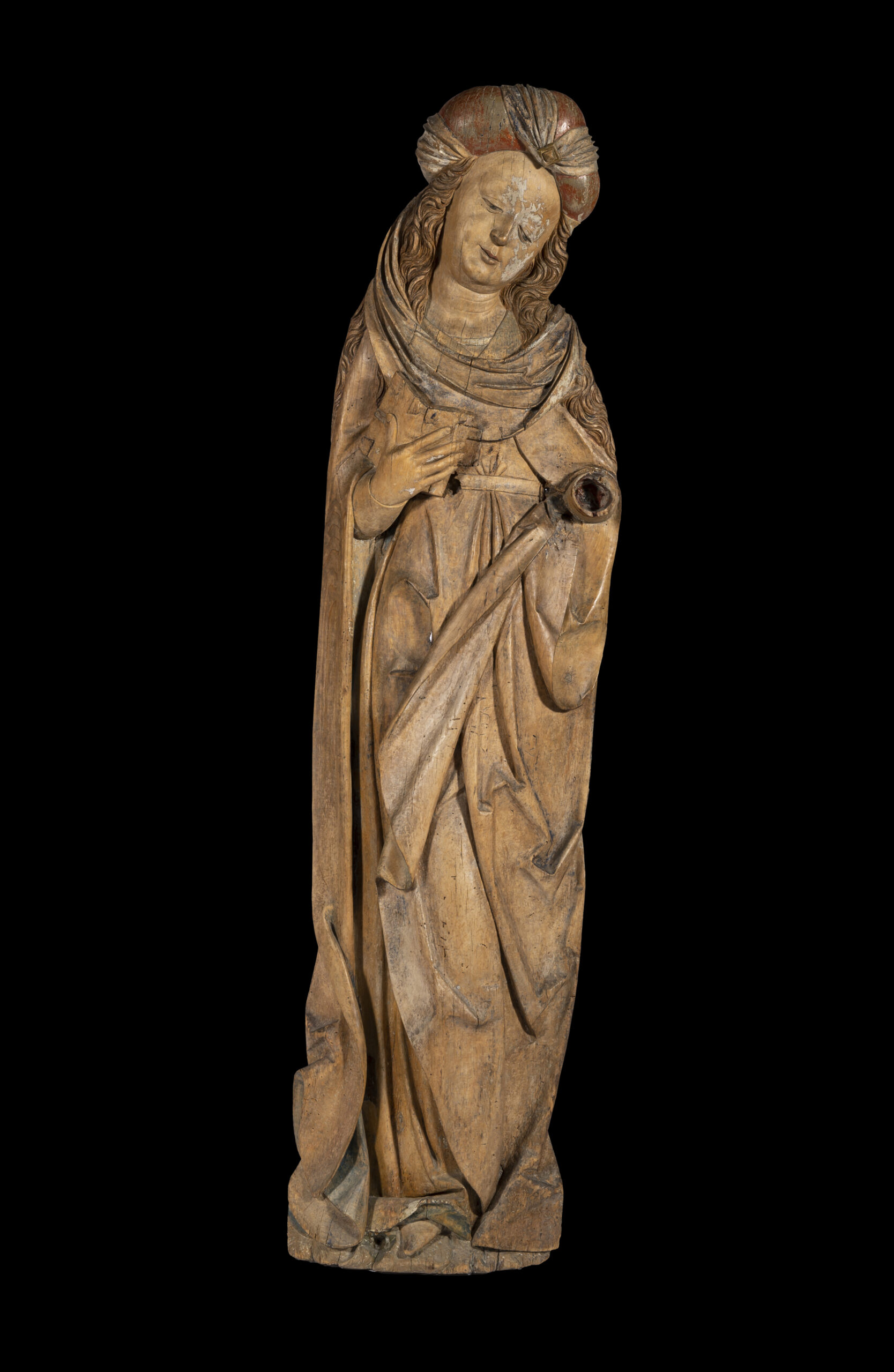
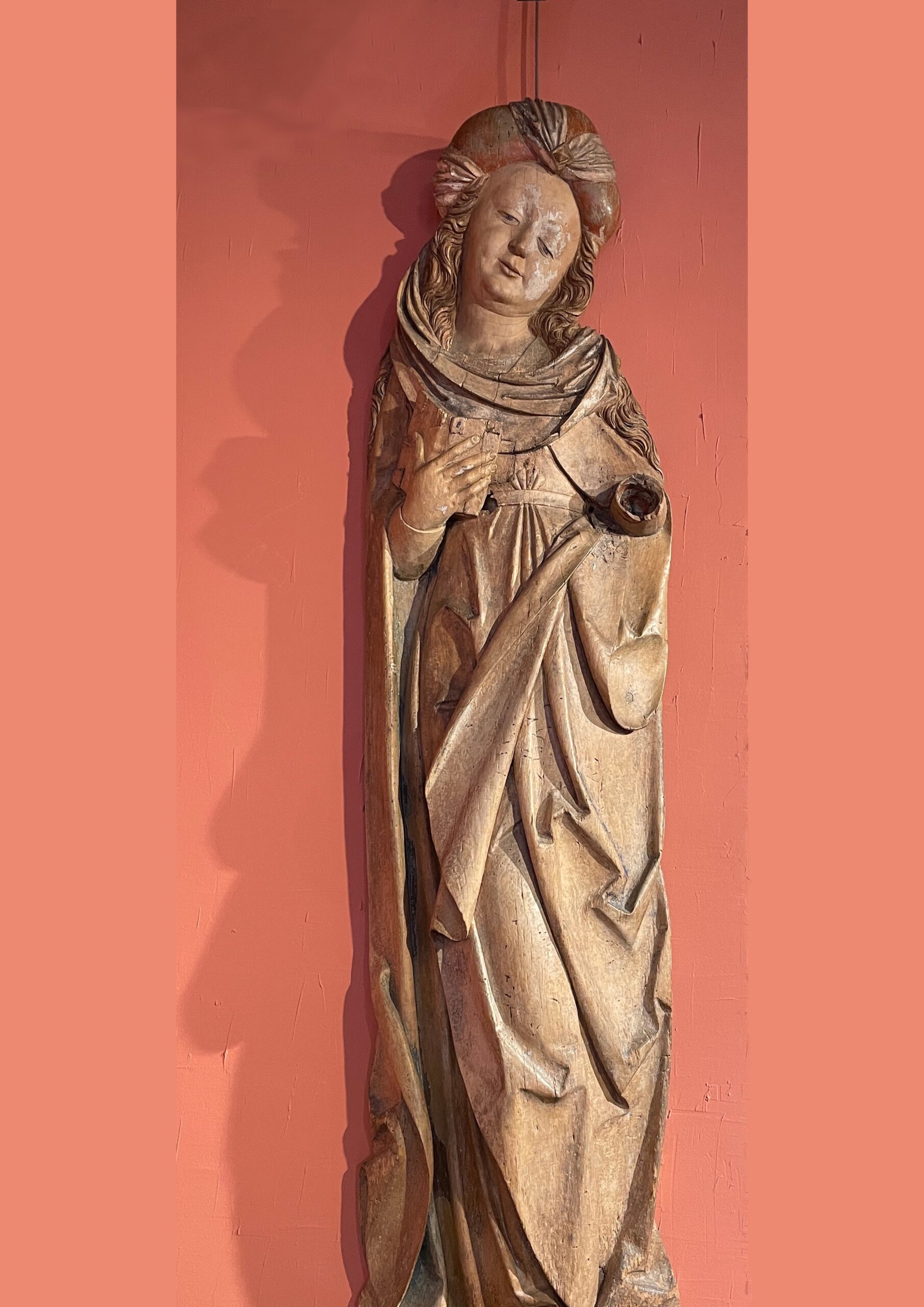
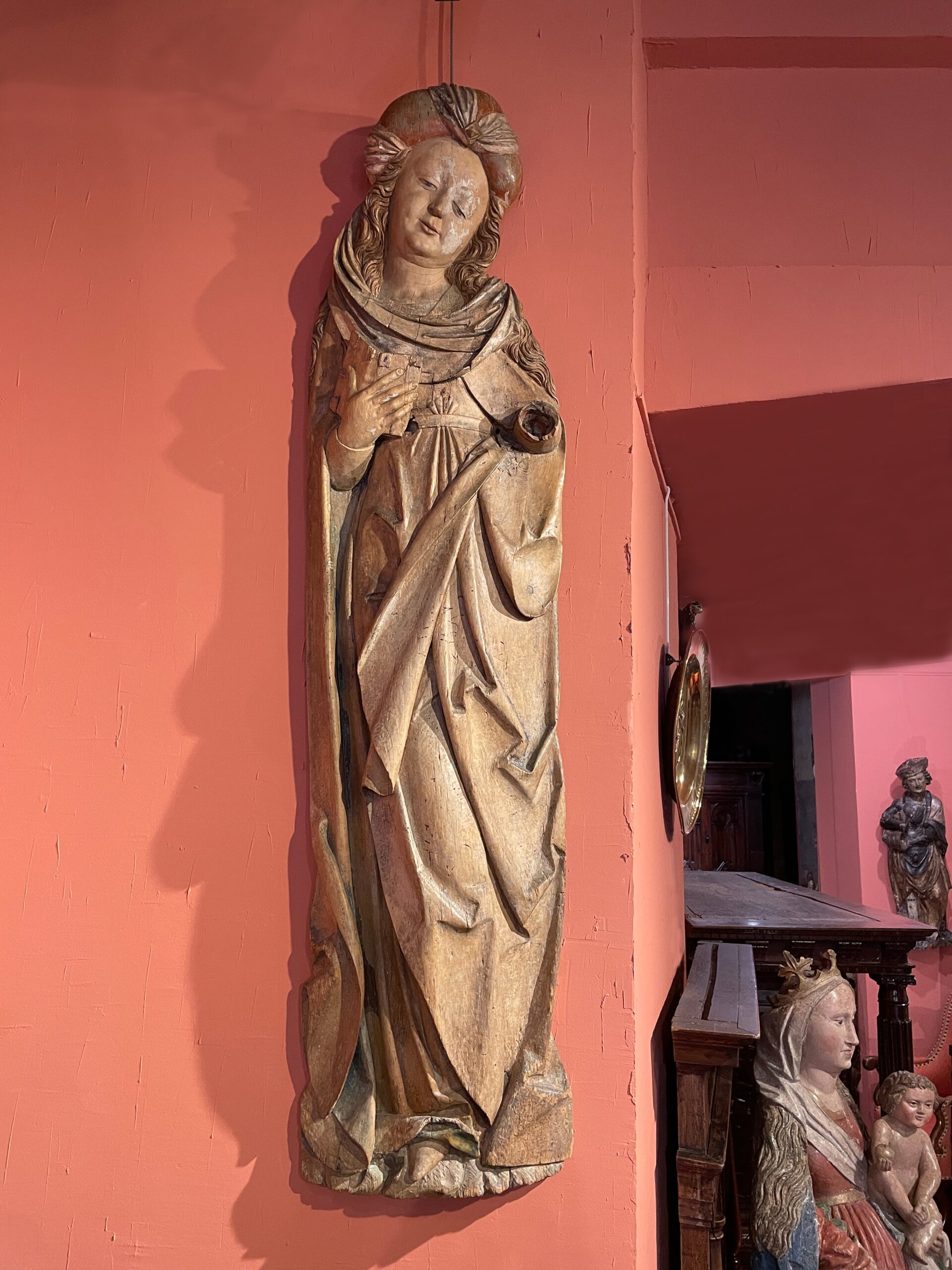
The sculpture shown here is perfectly in keeping with the “Spätgotik” movement. It is made from high-quality limewood. Limewood was particularly popular in sculpture throughout southern Germany from the mid-15th century onwards. This light, homogeneous wood allows for precise carving, a fine finish and a beautiful polish.
As an applique figure, it undoubtedly comes from an altarpiece.
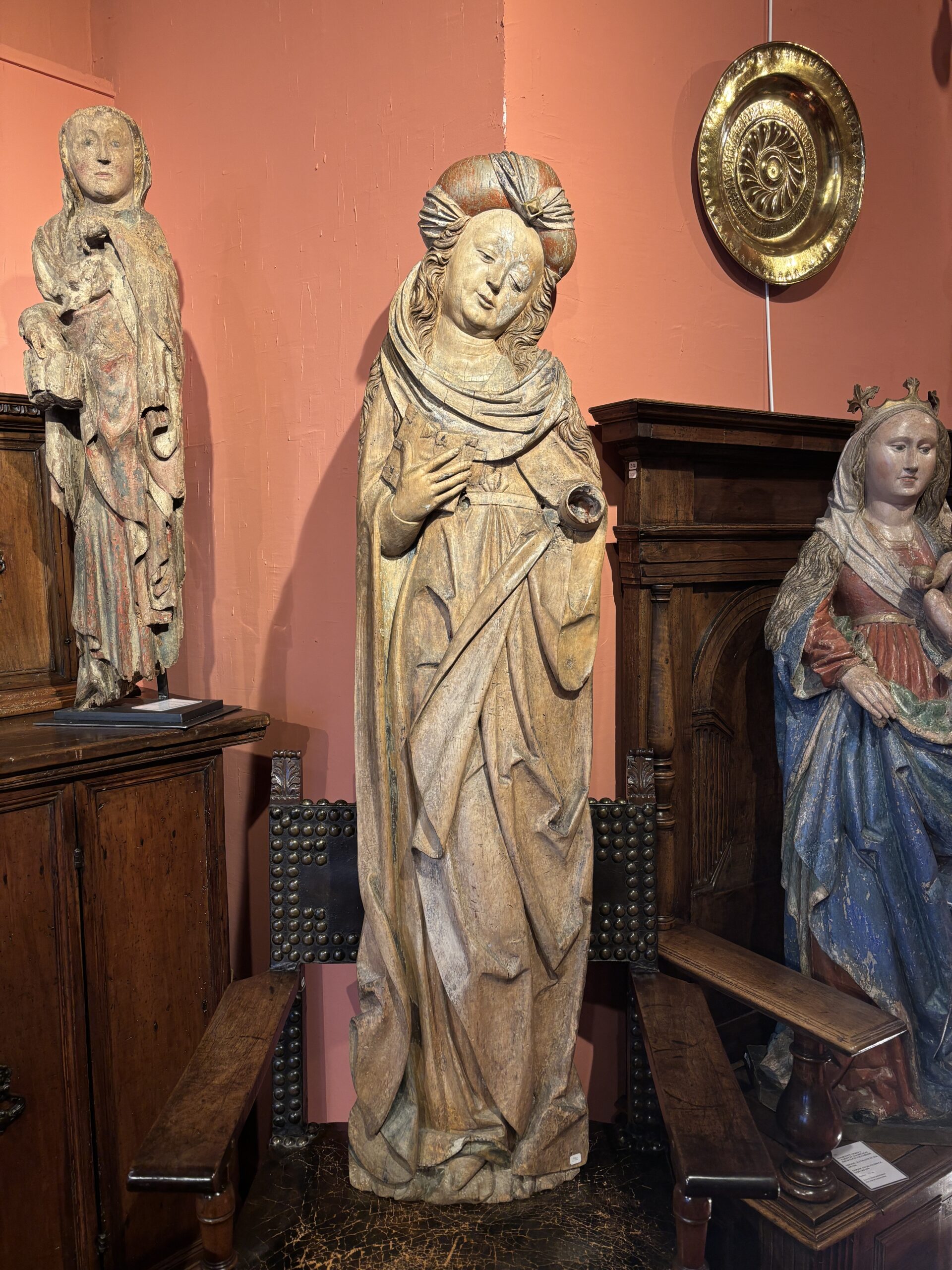
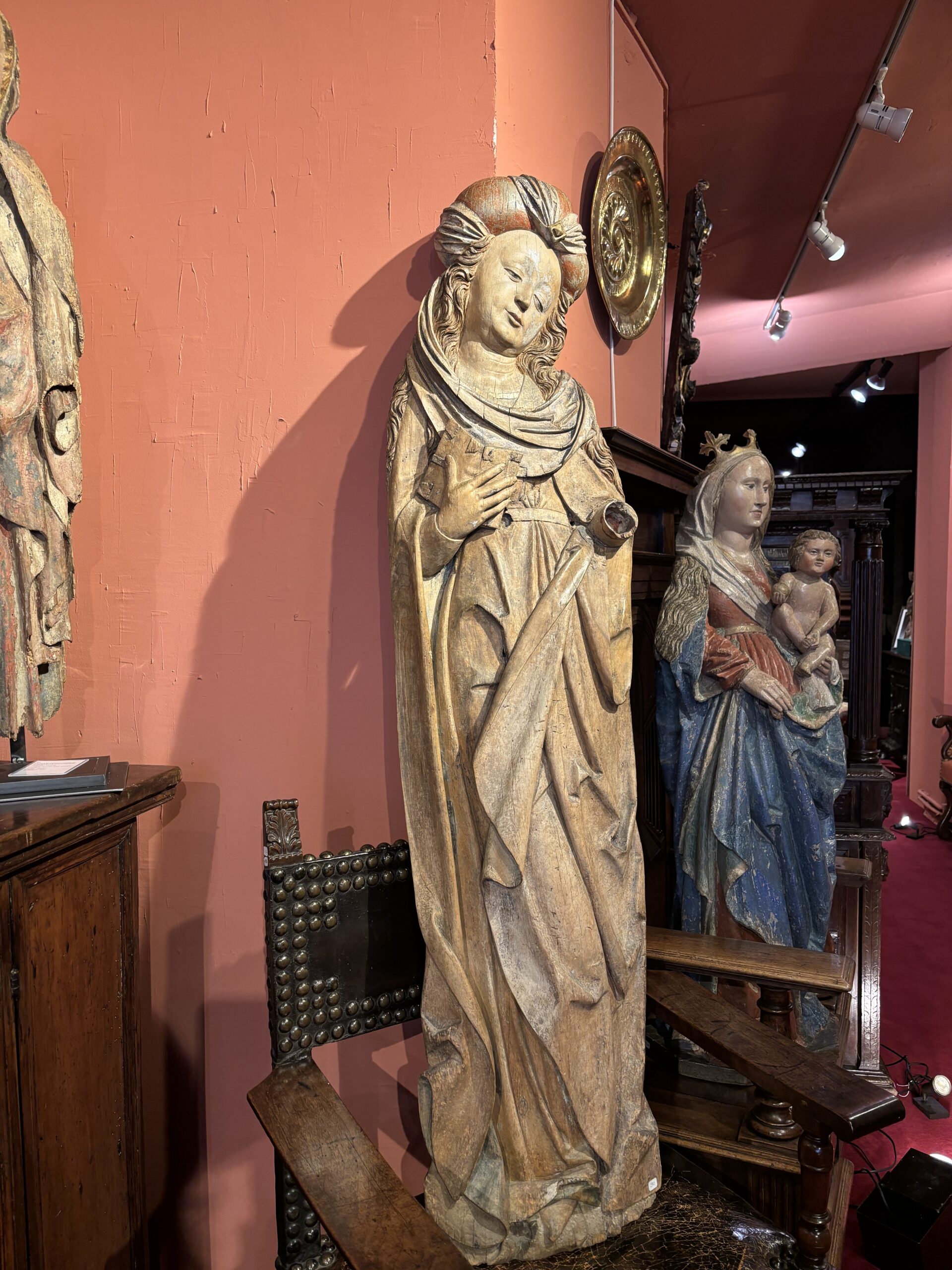
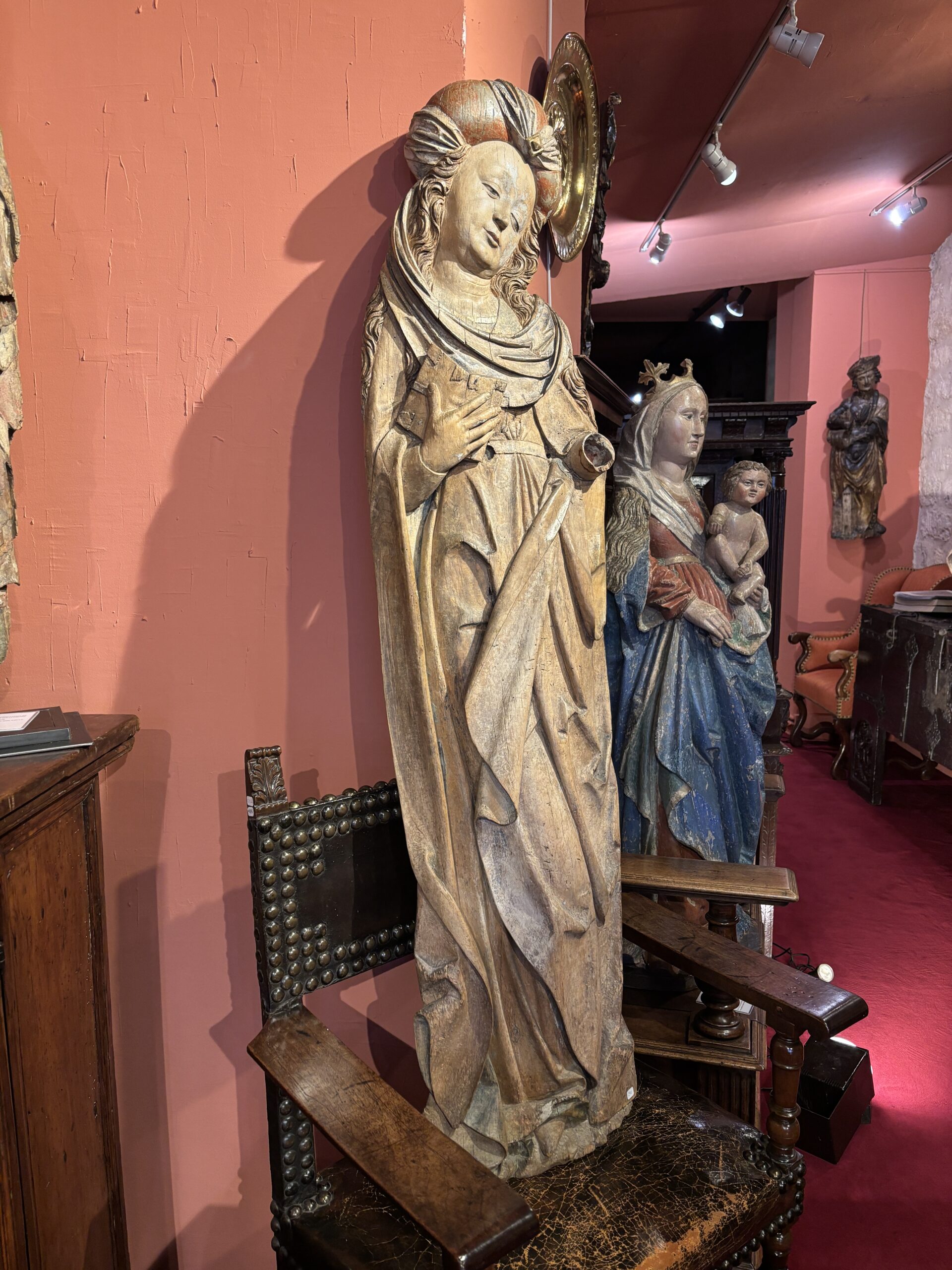
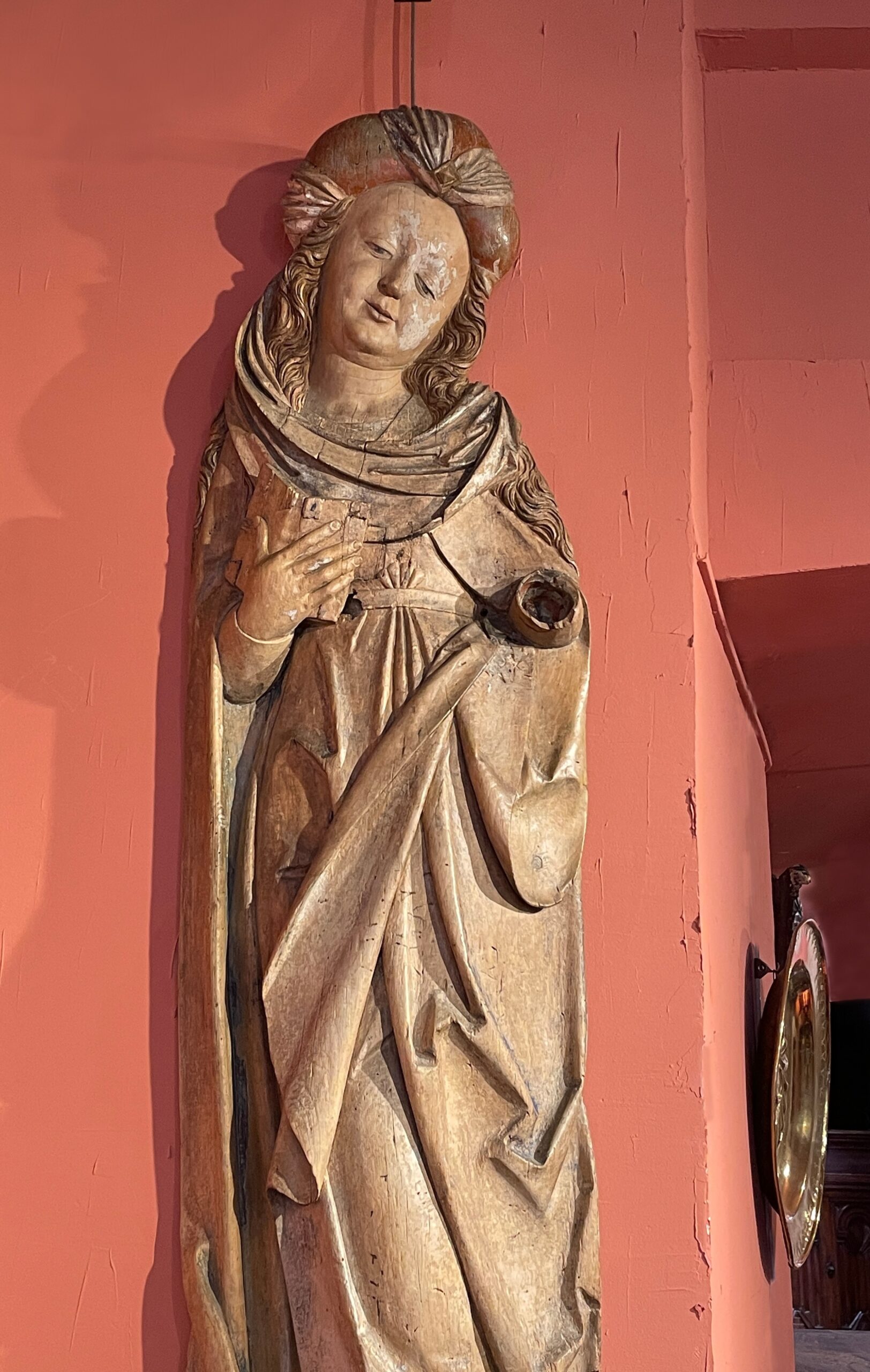
Our saint is shown standing. Her figure is slender and lanky. She is dressed in a gown, belted at the waist. A mantle covers her. Her knees protrude very slightly under her garment, influencing the folds of the drapery. The drape is marked by a succession of V-shaped folds and a few breaks at the feet. The fabric of the cloak is pulled back over the front of the body, with a few calm undulations on the edge.
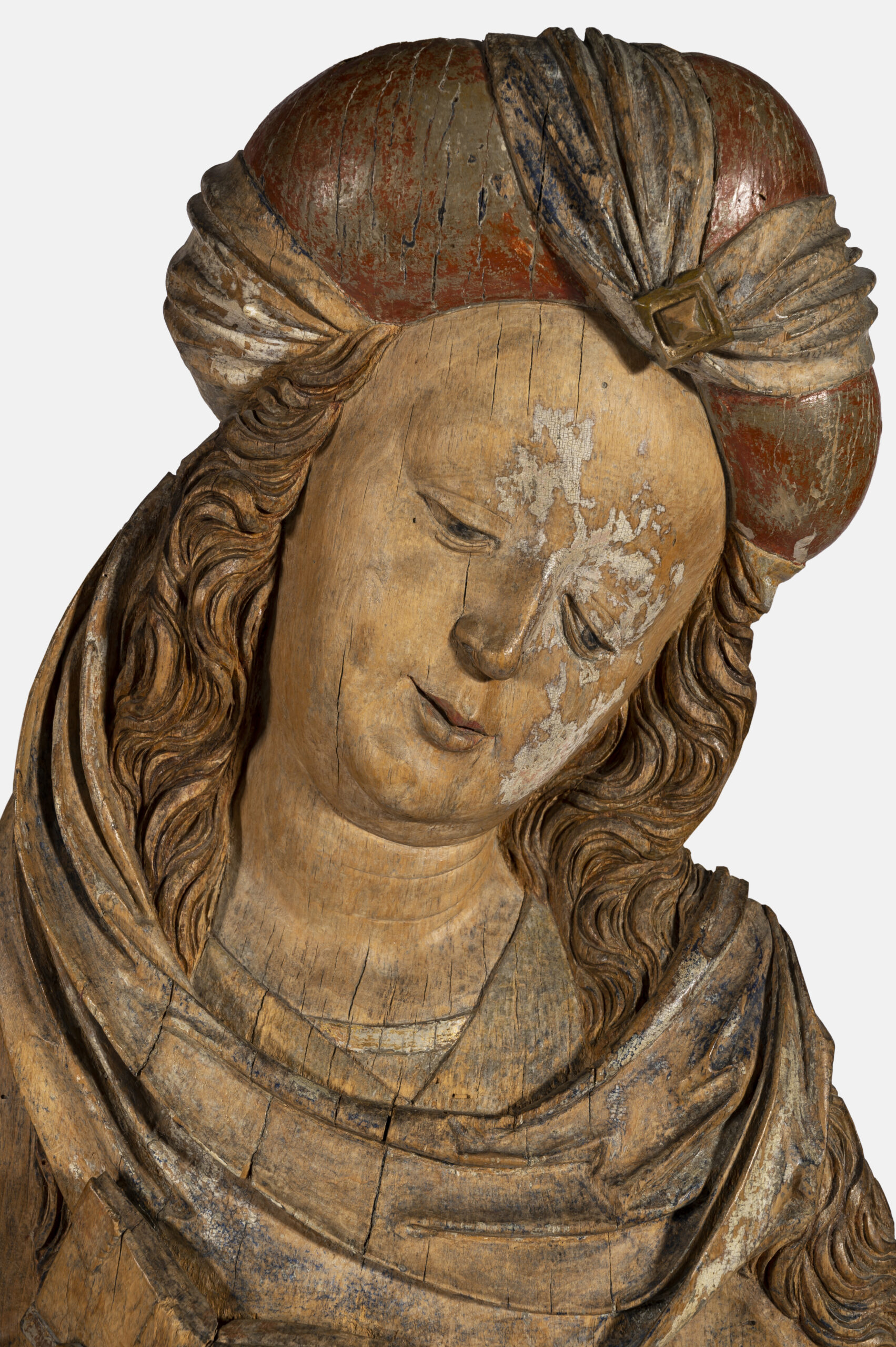
Her head, covered with a turban-like headdress, is tilted slightly to the left. The gentle, peaceful expression on her face, her pensive gaze beneath lowered eyelids, exude a sense of calm intimacy.
The oval shape of her full face, with its rounded forehead and pronounced double chin, her straight nose, thin lips with slightly upturned corners that hint at a smile, and her small round chin, indicate the influence of multi-Scherian sculpture.
Her wavy hair spills over her shoulders and down her back..
In her right hand, with its short but delicate fingers, she is holding an open book.
As the empty space left by the left hand suggests, it was attached to the sculpture rather than carved from the ground. This is typical of works from this period. Unfortunately, its absence prevents us from proposing a definite identification for this holy woman. Nevertheless, the “turban” on her head, commonly used in Swabian sculpture of the 15th century, indicates, like a crown, a noble birth.
In addition, her long, untied hair is reserved for young girls, while married or middle-aged women hide their hair under a veil.
It could therefore be Saint Catherine, Saint Ursula, Saint Agnes or Saint Barbara.
Saint Barbara seems to be the preferred hypothesis, as the attitude of the Saint holding her attribute in her left hand is consistent with Saint Barbara holding a chalice often surmounted by a host. The book was also an attribute of Saint Barbara.
The Saint’s gentle expression, quiet grace and tender sensitivity are typical of Swabian Gothic sculpture. The various features of the sculpture mentioned above show a dependence on the late work of Hans Multscher’s workshop in the decades between 1450 and 1460.
This places the production of the sculpture shown here, in Ulm, in the last decades of the fifteenth century, around 1480.
BIBLIOGRAPHY
Michael Baxandall, South German Sculpture, 1480-1530, Victoria and Albert Museum, 1974.
Damien Berné (ed.), Sculptures Souabes de la fin du Moyen Age, Editions de la Réunion des musées nationaux, 2015.
Jacqueline Boccador, Les diverses tendances du Spätgotik, Dehon, Paris.
Collectif, Dévotion et séduction , Swabian sculptures in the museums of France, circa 1460-1530.
Collective, Sculptures allemandes de la fin du Moyen Age dans les collections publiques françaises, 1400-1530, Louvre.