



Description
After having waged war in Italy, The King François Ier, really inspired by his discoveries, called Italian artists, craftmen and cabinet-makers, to work in France.
L’Ecole de Fontainebleau with Rosso Fiorentino usually called Le Rosso (student of Raphaël) and Le Primatice working there for the « Galerie François Ier », initiate the former bases of the Italian decorative art.
The splendid sculptural stucco composition of the central frescoes will become a model for next generations of artists.
Three famous theorists of Art
Jacques Androuet du Cerceau (1510 – 1585) designer, architect and engraver,
Philibert de l’Orme ou Delorme (1510 – 1570) designer and architect,
Jean Bullant (1520 – 1578) architect,
Published very influential engraved designs for silver, furniture and textiles
During the reign of the king Henri II (1547 – 1559) and Catherine de Médici’s regency, they all contribute to spread the iconography of Renaissance Ornamentation through the country, exalting the French Renaissance furniture to the top.
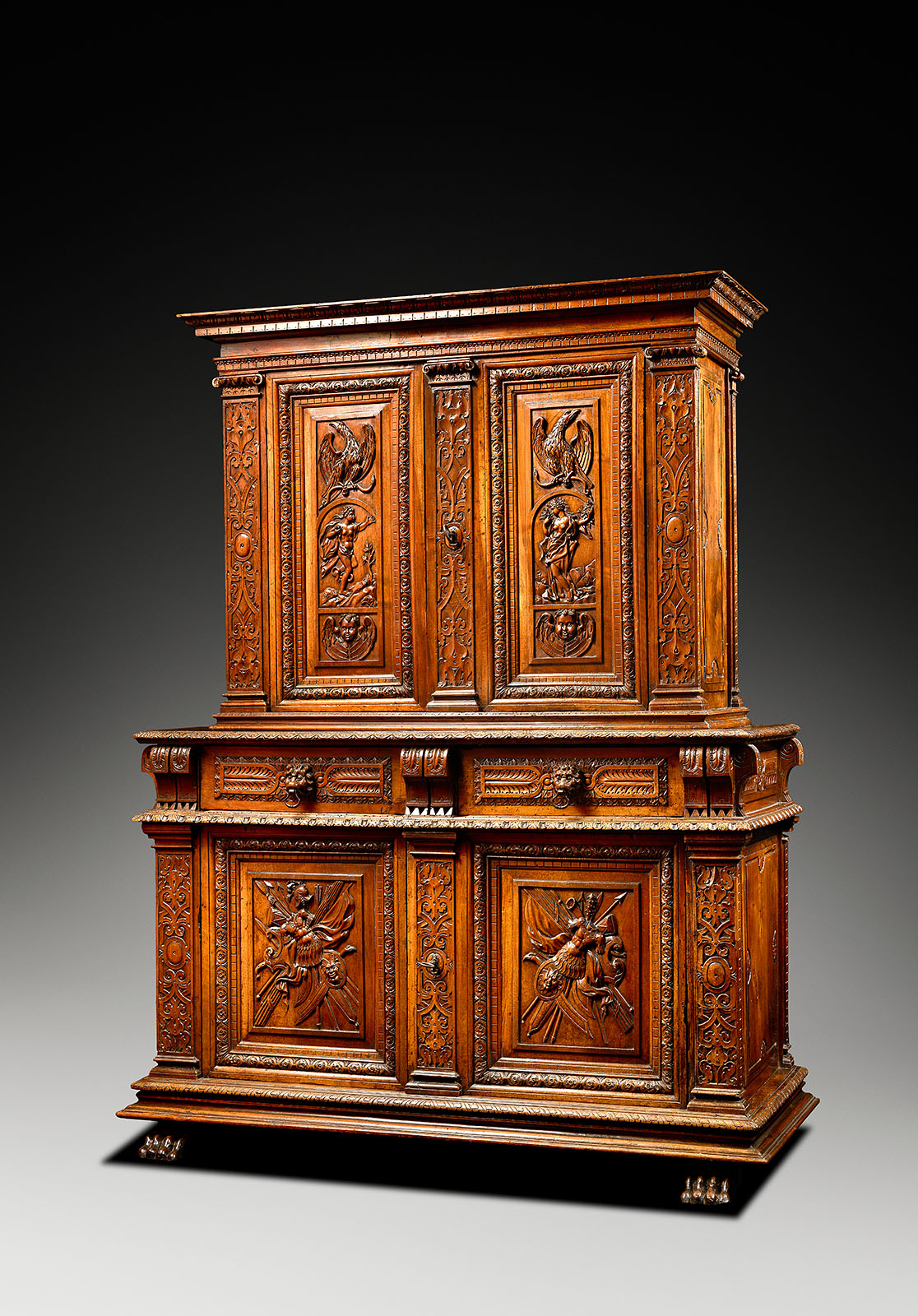
We may note the superb combination of a strong architectural outline with finely executed carving so characteristic of the lyonnais school during the Second French renaissance period.
Concerning the carved decoration and structure , one can clearly see the influence of Philippe de l’Orme, with the Ionic capitals and the ovoloes punctuating the pilasters on the façade and the foliate carvings, all seem to derive from his Livre VII du Traité d’Architecture (1567). Futhermore, he was very respectful about the Antic architecture purity of lines. Indeed, the ornementation was more concentratre on pilasters and consoles.
The presence of the nice divinities denotes an inspiration from the Bellifontain Art of this time.
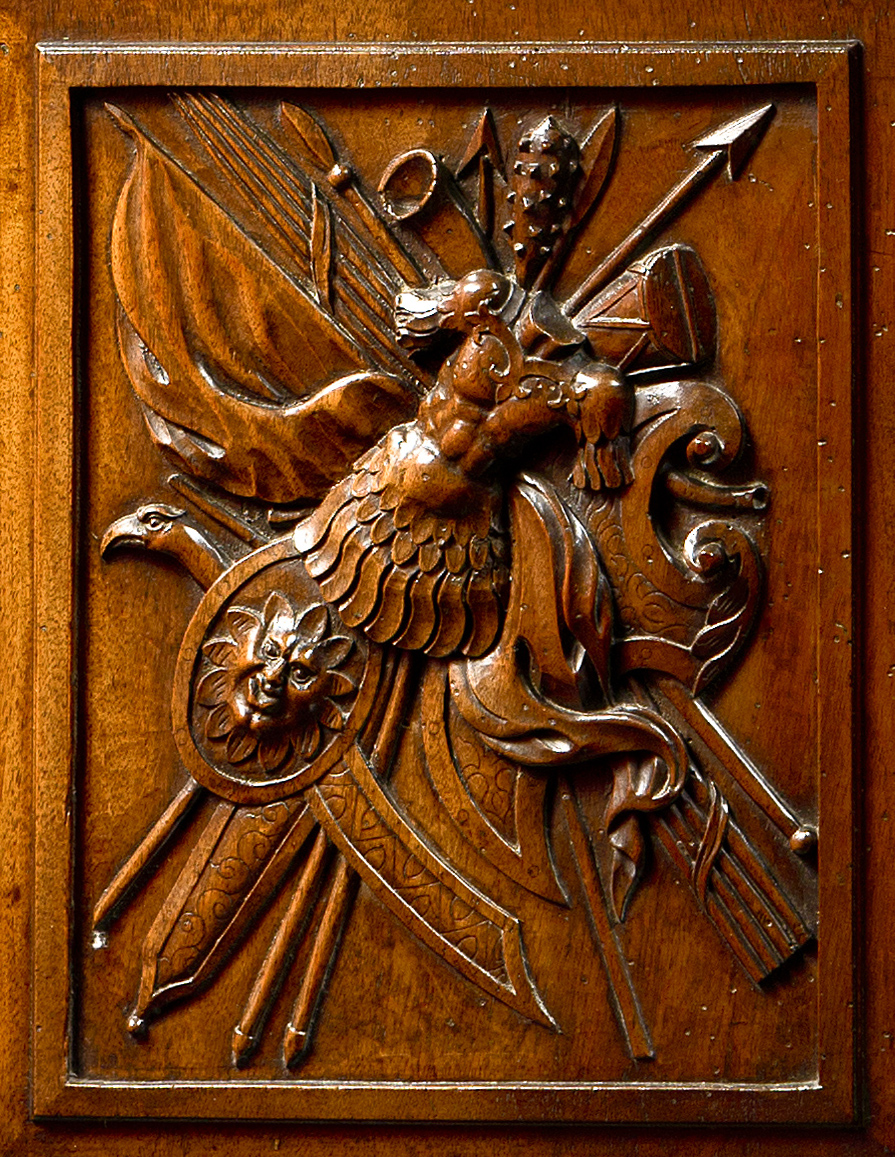
This is a two parts buffet,the upper one setting back. The panelled doors depict mythological divinities and two drawers on the waist interposed by double carved consoles . The nice carved panels of the lower part depict trophies.
The Lower part
On a ternary rhythm with his nice carved pilasters, the lower part in based on a water leaf border above lion’s feet.
The panelled doors are centred by richly ornate trophies comprising swag of warriors patterns such as : armor, flags, drums, arrows and shields on a geometrical and symetrical composition. All these patterns are inspired by the treaties of Jacques Androuet Du Cerceau named : Les Grands Trophées de Jacques Androuet Du Cerceau
On the waist, the drawers are adorned with quill-feather frieze and centred by a beautiful lion’s head. The leaf ornated double consoles on each side, underline the ternary rhythm of the Cabinet.
The Upper Part
The upper body setting back boasts a pair of flowerhead framed panelled doors depicting mythological goddess.
On the left, Eurydice, wife of Orpheus, is well known for having danced with naiads on her wedding day. Stepping on a viper, she was bitten and died immediately.
On the right, is depicted Ceres, goddess of agriculture, grain crops, fertility and motherly relationships.
They are placed in the center of a round top cartouche, above the head of Putti and below nicely carved aigles.
The sides of the Cabinet are delicately carved of moulded panels including semi-patera on the borders.
This Cabinet with a nice quality of execution is a perfect exemple of artwork made by French cabinet-makers from the 16th century Second Renaissance.
Perfectly preserved, this cabinet still has its original green silk covering, held with cross-motifs braid and studs.
Bibliography
BOCCADOR Jacqueline, Le mobilier français du Moyen Age à la Renaissance, éditions d’art Monelle Hayot, 1988, p. 201-252.