



Description
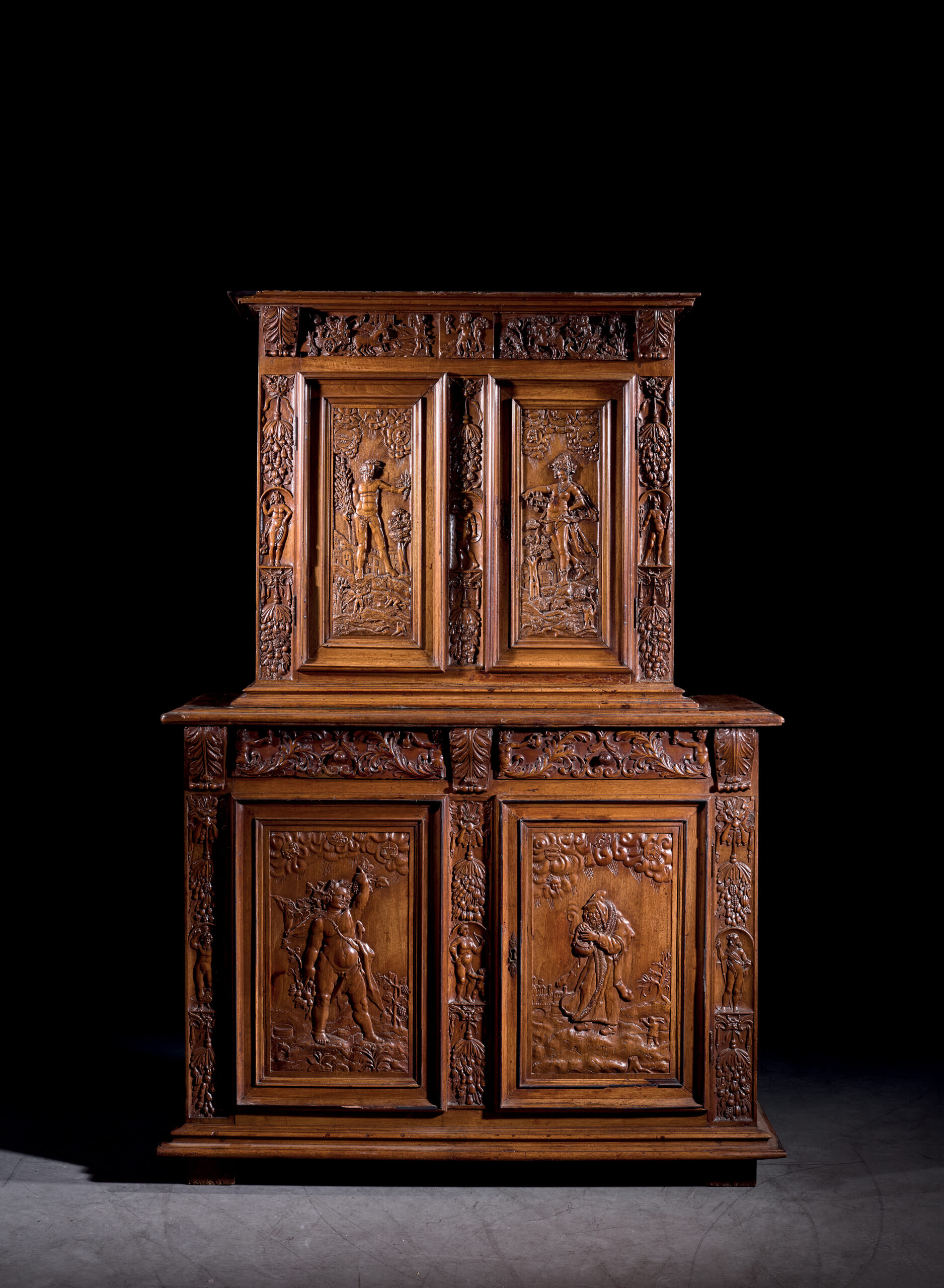
This rare Renaissance period cabinet displays rich sculptural decoration depicting the Four Seasons on its doors, complemented by allegories of Abundance and Prosperity, as well as mythological figures. The piece features a refined architectural structure enriched with elaborate ornamentation.
The cabinet is composed of two sections, upper and lower, articulated in a ternary rhythm. Two uprights and a central stile, decorated with mascarons, fruit garlands, and deities, frame four doors arranged in pairs.
Upper Section
The upper section is topped by a richly carved entablature framed by two elegant projecting consoles adorned with acanthus leaves.
At the center of the composition stands an allegory of Abundance, holding in one hand a cornucopia overflowing with riches and in the other a floral bouquet. This central medallion serves as the iconographic keystone of the cabinet.
On either side, two war-like scenes face each other.
On the left, a soldier drives two spirited horses pulling a chariot. Behind them, two captives are tied back to back, while trophies of arms complete this symbol of defeat — a motif inherited from the classical tradition and likely inspired by engravings.
On the right, two winged horses draw the victorious soldier, carried by his triumph toward the gods. His tunic billows in a virtuoso play of drapery as he raises a scepter in his right hand. The relief is set within a distinctive composition, unexpectedly featuring a rabbit and a small bear.
The four door panels are devoted to another highly symbolic theme : the cycle of life and the passing of time.
Right panel – Spring : A graceful allegorical figure carries a basket overflowing with flowers. She is crowned with leaves, adorned with armlets and multiple necklaces. A large windblown drapery enhances her nude figure. Beneath her feet spreads a lush, verdant ground, while in the background rises a cityscape with a tower and a church. In the sky, three medallions show the zodiac signs associated with the season — Aries, Taurus, and Gemini.
Left panel – Summer : A robust, bare-chested man with windblown hair holds a sheaf of wheat and a bouquet of hops. At his feet, two men work in the fields: one harvesting with a sickle, the other binding the sheaves. A distant town anchors the scene in a landscape. Above are the zodiac signs of Cancer, Leo, and Virgo.
The frieze below features three consoles decorated with large acanthus leaves framing two deeply carved drawers, echoing the entablature above. Two atlantes with foliate scroll bodies raise a pitcher and a wine cup, as if toasting.
Lower Section
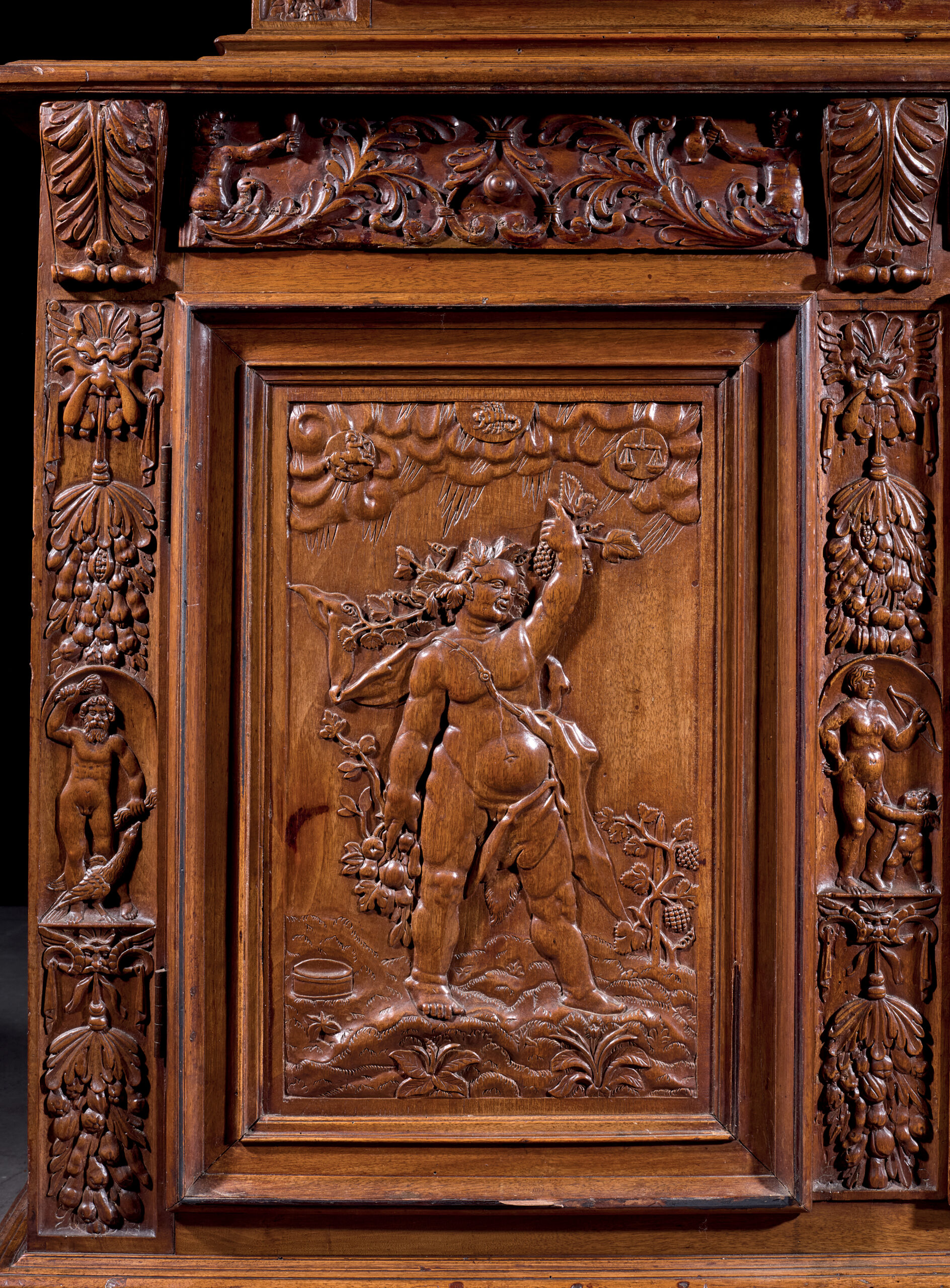
Left panel – Autumn : A round, robust allegory points toward the sky. Shown nude and partially draped, he is surrounded by cascades of apples, grapes, and dense foliage evoking the grape harvest season. This Bacchic figure advances on a mound with a barrel and a vine at his feet. In the turbulent sky above appear the zodiac signs of Libra, Scorpio, and Sagittarius.
Right panel – Winter : Personified as an old man wrapped in a fur-lined coat and wearing a pointed cap, Winter warms his hands over a flaming urn. To either side appear a fortified town and a bare tree. Above, heavy clouds part to reveal a putto’s head blowing the winter wind, while the zodiac signs Capricorn, Aquarius, and Pisces are inscribed overhead.
The Four Seasons were among the most popular themes commissioned in the 16th century. The refined plasticity of these allegories reflects the humanist culture and scholarly taste of the patron, sensitive both to the beauty of form and to the symbolic language of attributes. Later, Cesare Ripa codified these themes in his famous Iconologia (1603). The inclusion of zodiac signs gives this cabinet an exceptional character: such motifs are rarely documented in Renaissance furniture and reveal a visual culture enriched by rare Flemish pictorial models and engravings.
Uprights and Central Stiles
A regular decorative scheme of mascarons and garlands of fruits – grapes, apples, pears, pomegranates, and quinces – frames six mythological deities distributed across the architectural elements.
Upper left : Diana, crowned with her crescent moon.
Center : Mars, the warrior god, with helmet, shield, and sword drawn.
Upper right : Hermes, with winged sandals, petasos hat, caduceus, and trumpet of Fame – recalling his role as messenger.
Lower left : Jupiter, holding the thunderbolt, accompanied by his eagle.
Center : Venus, holding Cupid’s bow, with Cupid at her side.
Lower right : Hades, identifiable by his scythe.
This rare and finely detailed iconographic program, inspired by engraved ornamental pattern books, revolves around themes central to the art of the French Second Renaissance : Abundance, Triumph, and Posterity. The cabinet’s precise construction and balanced proportions testify to the vitality of a workshop in southern France, influenced by Italian ornamental vocabulary and Flemish iconography.