



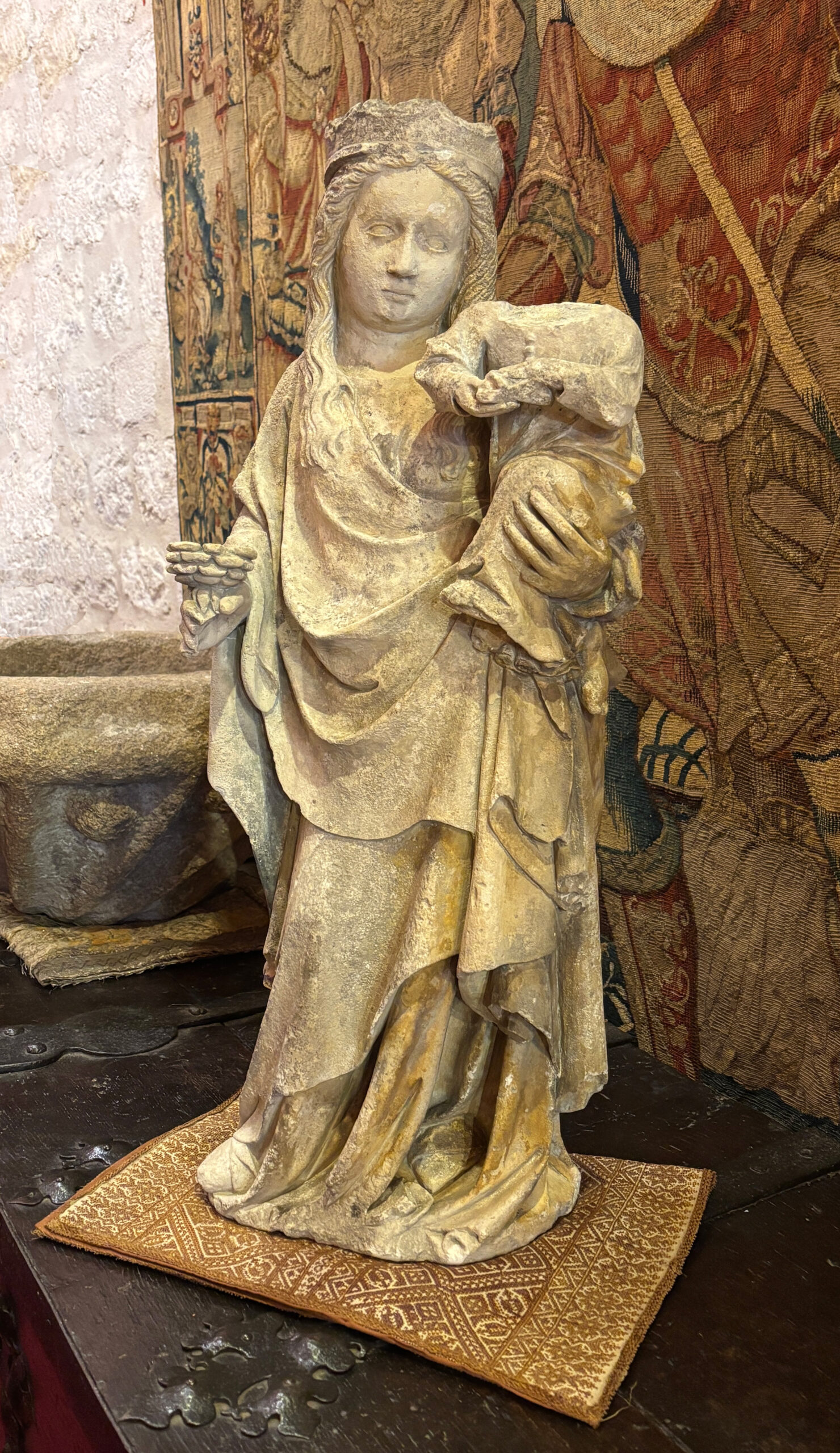
Description
Historical Context
Located between the Moselle and Meuse valleys, bordered by the Vosges Mountains to the south and the Duchy of Luxembourg to the north, the Duchy of Lorraine emerged through a series of territorial divisions. Its origins can be traced back to the 9th century, with the partition of the Carolingian Empire, when Lothair I inherited Lotharingia. In 959, the territory was further divided into Lower and Upper Lotharingia — the latter laying the foundations for the future Duchy of Lorraine. The duchy remained under the authority of the Holy Roman Empire until 1736, when it was annexed to the Kingdom of France.
Throughout its history, Lorraine occupied a strategic position at the heart of political and military rivalries, often shaped by shifting alliances and conflicts.
Its geographical location at a cultural crossroads also made Lorraine a fertile ground for artistic exchange. By the late 13th century, the region had become an important artistic center, where a distinct type of Virgin and Child sculpture emerged.
According to Professor Schmoll, the characteristic features of this Lorraine style first appeared around 1280–1300, rooted in the sculpture of the Aube region. The figures are marked by strong volumes, restrained movement, rare yet solemn gestures, and a severe, deeply introspective expression. These Virgins share a recognizable physiognomy: a broad forehead, a shield-shaped or full oval face, a strong neck, small lips, and a chin dimple.
Description
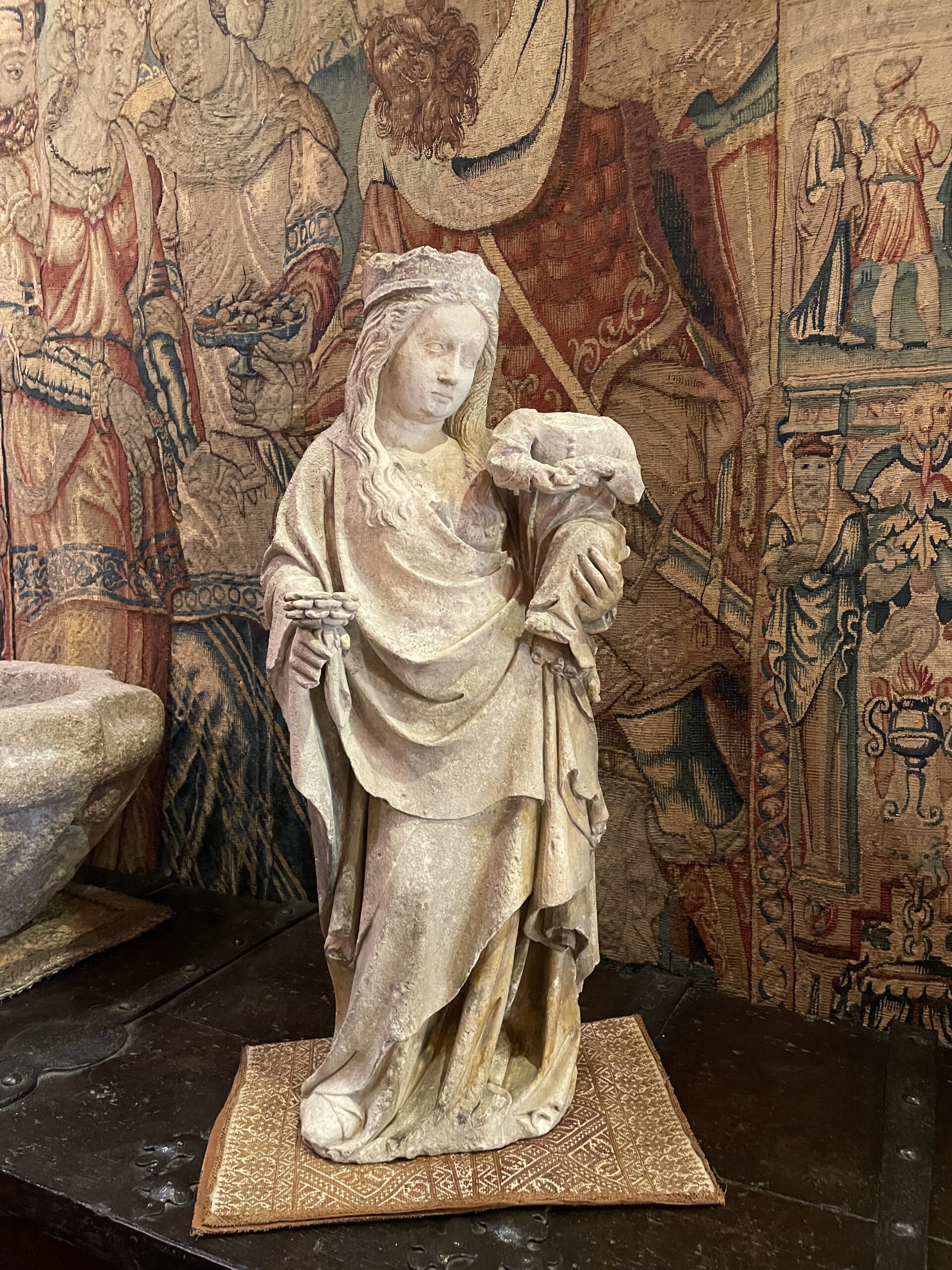
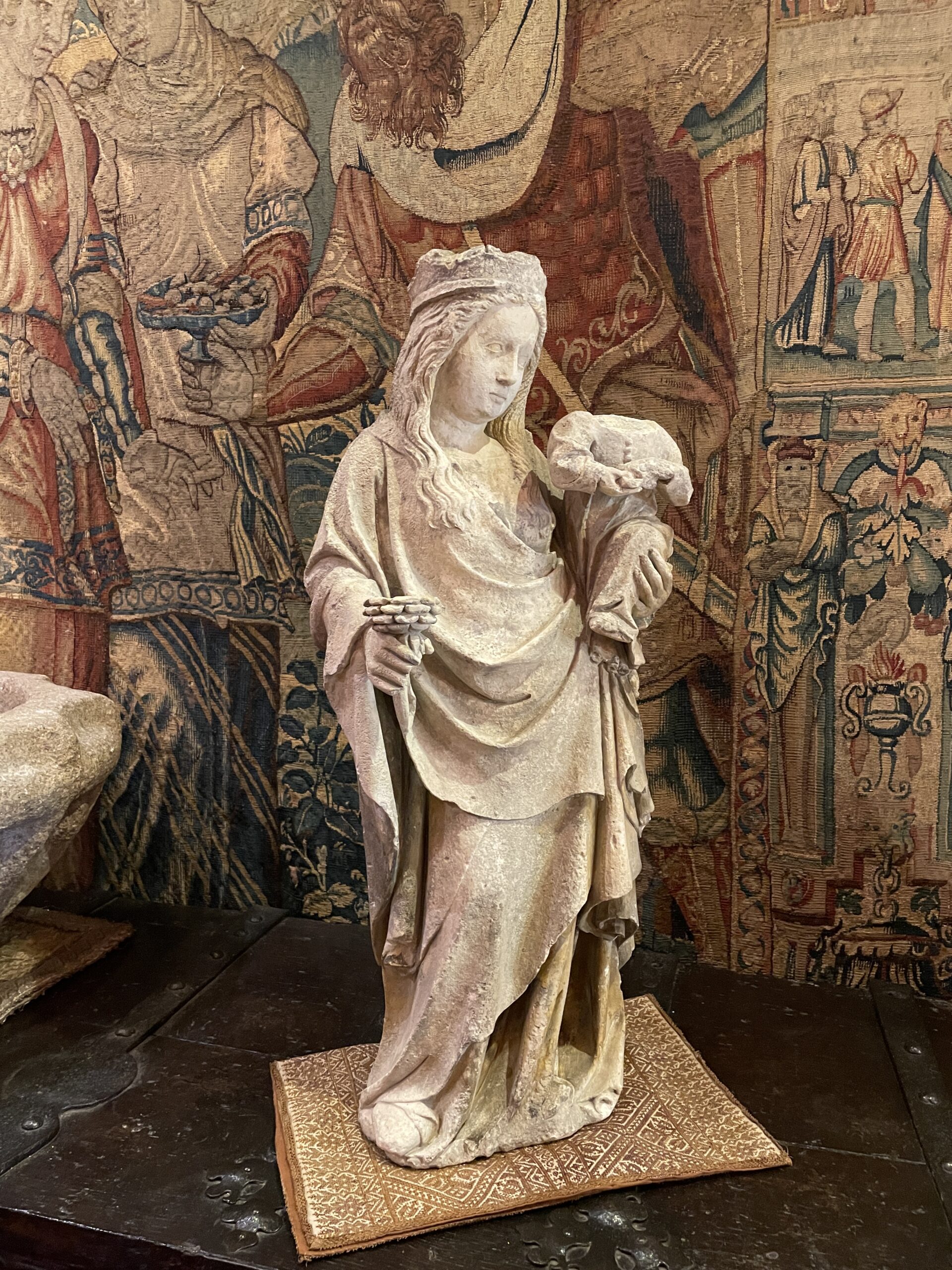
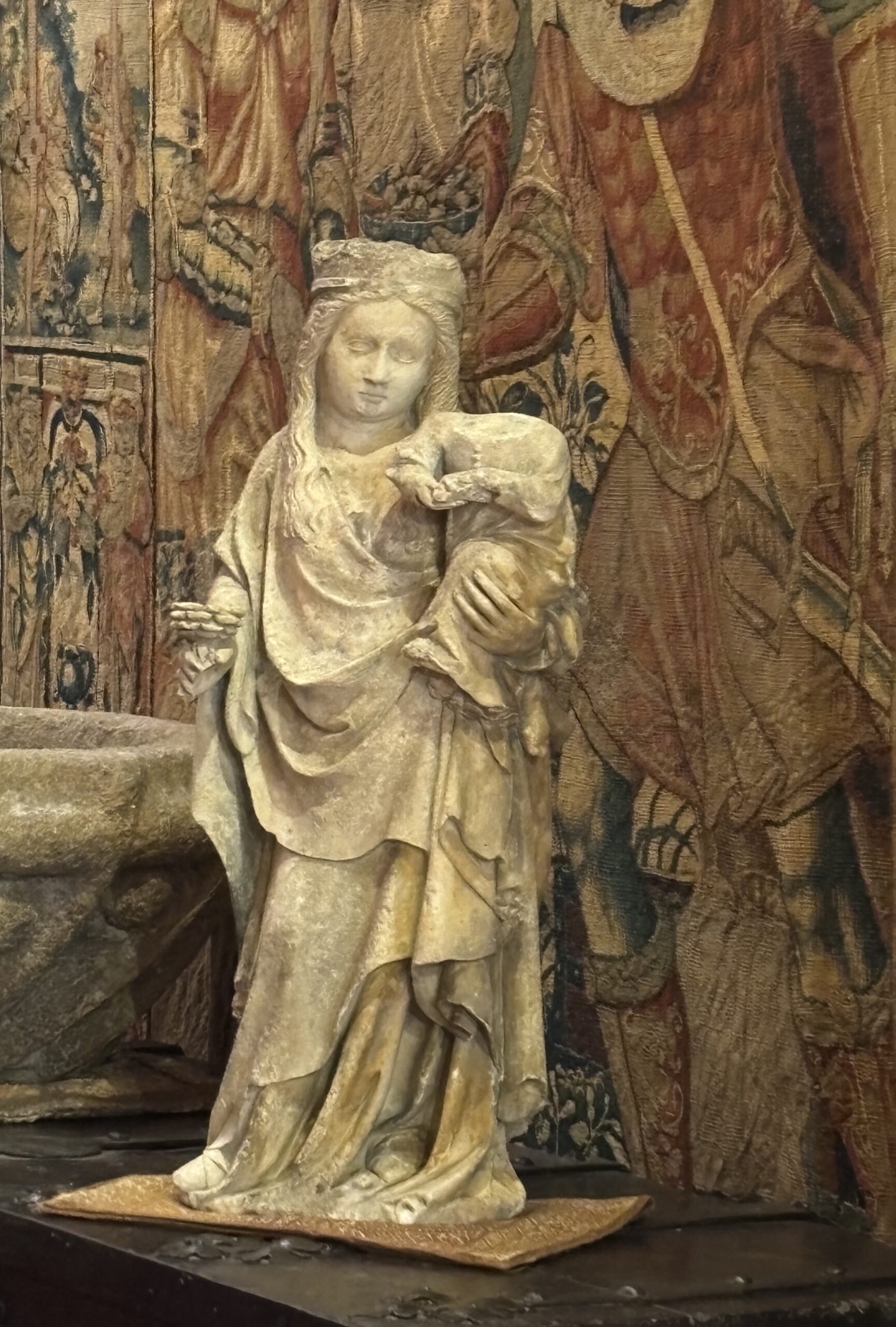
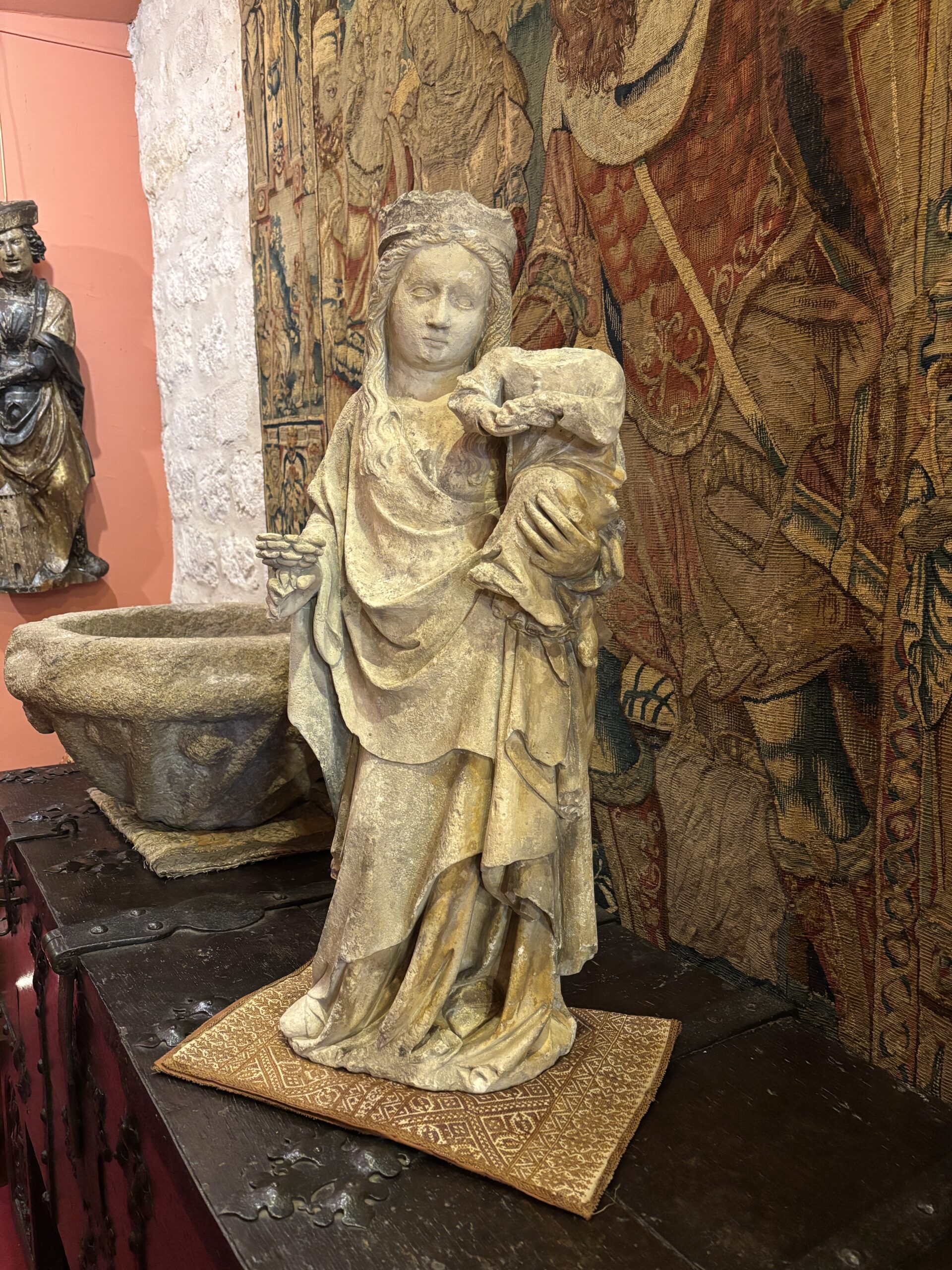
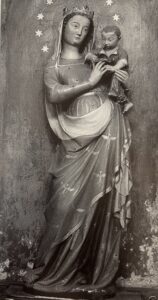
Of impressive dimensions and strong posture, this beautiful Lorraine Virgin and Child from the 14th century is carved in the round from hard limestone.
Standing upright, the Virgin displays a graceful contrapposto stance, naturally dictated by the weight of the Child she carries on her left side. Her right knee is bent, and the tip of her foot emerges beneath the folds of her robe. The statue’s majestic bearing is further enhanced by the movement of the drapery.
The Child wears a long tunic buttoned at the collar, with his small foot peeking out from below. He holds an open book in his hands and smiles gently with a vivid, childlike expression.
The Virgin’s youthful face, softly modeled, reflects the typical characteristics of Lorraine sculpture: elongated eyes tapering toward the temples, a straight nose, and fine lips. Her distant gaze is emblematic of 14th-century Virgins. In her right hand she holds a single flower — a large dog rose (Rosa mystica), a particularly popular attribute in Lorraine as a symbol of the Virgin Mary and the Christ Child.
Her head is encircled by a crown resting on her long wavy hair, which frames her face and falls in locks over her chest. She wears a long mantle that cascades down her back in wide, deep folds and returns to the front in an elegant tablier drapery. Beneath it is a simple gown with a modest neckline and finely pleated, tightly pressed folds falling to her feet.
Comparative study :
In Joseph Adolph Schmoll’s renowned work Die Lothringische Skulptur des 14. Jahrhunderts, notable similarities can be observed between this sculpture and several documented Lorraine Virgins, particularly:
Virgin and Child, Rodin Museum collection, Co.01424
– Mid-14th century
– Mantle draped in tablier form
– Crowned head
– Child in long tunic with foot showing at the front
– Similar facial traits and expression
– Comparable silhouette, posture, and overall presence
– The original flower (Rosa mystica) is unfortunately missing.
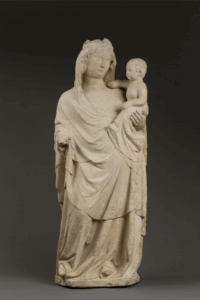
In Dr. Schmoll’s reference work on Lorraine Virgins, several other examples of Virgin and Child sculptures are particularly noteworthy:
The Madonna of Vallières (Metz-lès-Bordes), Kat. Nr. 174, p. 276
– Mantle treated in a flat manner, gathered in a tablier fold and falling over the left arm.
– Child dressed in a simple shirt, barefoot.
– Short-stemmed scepter with a flower rosette positioned almost horizontally.
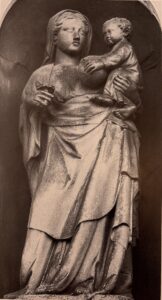
The Madonna of Bleurville, Kat. Nr. 306, p. 471
– She wears a crown that reveals her wavy locks framing her face.
– In her right hand, she delicately holds the large dog rose (rosa mystica), an attribute of the Virgin Mary that was particularly popular in Lorraine.
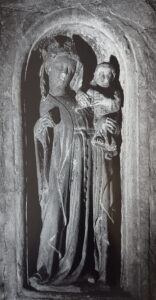
The Majestic Standing Madonna of Baroville, Kat. Nr. 348, p. 519
– Mantle arranged in a tablier fold.
– Right foot extending forward from the freely swinging right leg, with a slight rotation above the left hip.
– Large flat rose with double leaves, held delicately between the index and middle fingers of the Madonna’s right hand, positioned almost horizontally.
– Lively and playful Child dressed in a long tunic, with his small feet visible.
Bibliography:
– William H. FORSYTH, Medieval Statues of the Virgin in Lorraine related in type of the Saint-Dié, Metropolitan Museum studies.
– J. A. SCHMOLL, gene. Eisenwerth, Die Lothringische Skultur des 14. Jahrunderts, Michael Imhof Verlag, D-36100 Petersberg, 2005
– RODIN Museum Collection, Paris.