



Description
Originally from Magdala, a fishing town on the western shore of the Sea of Galilee, Mary Magdalene was one of Jesus of Nazareth’s closest disciples, following him until his final days.
The Gospel of Saint Mark attests to her presence at both the Crucifixion and the Entombment of Christ. Moreover, after the Resurrection, Jesus chose her as the first witness of the miracle, even before his apostles.
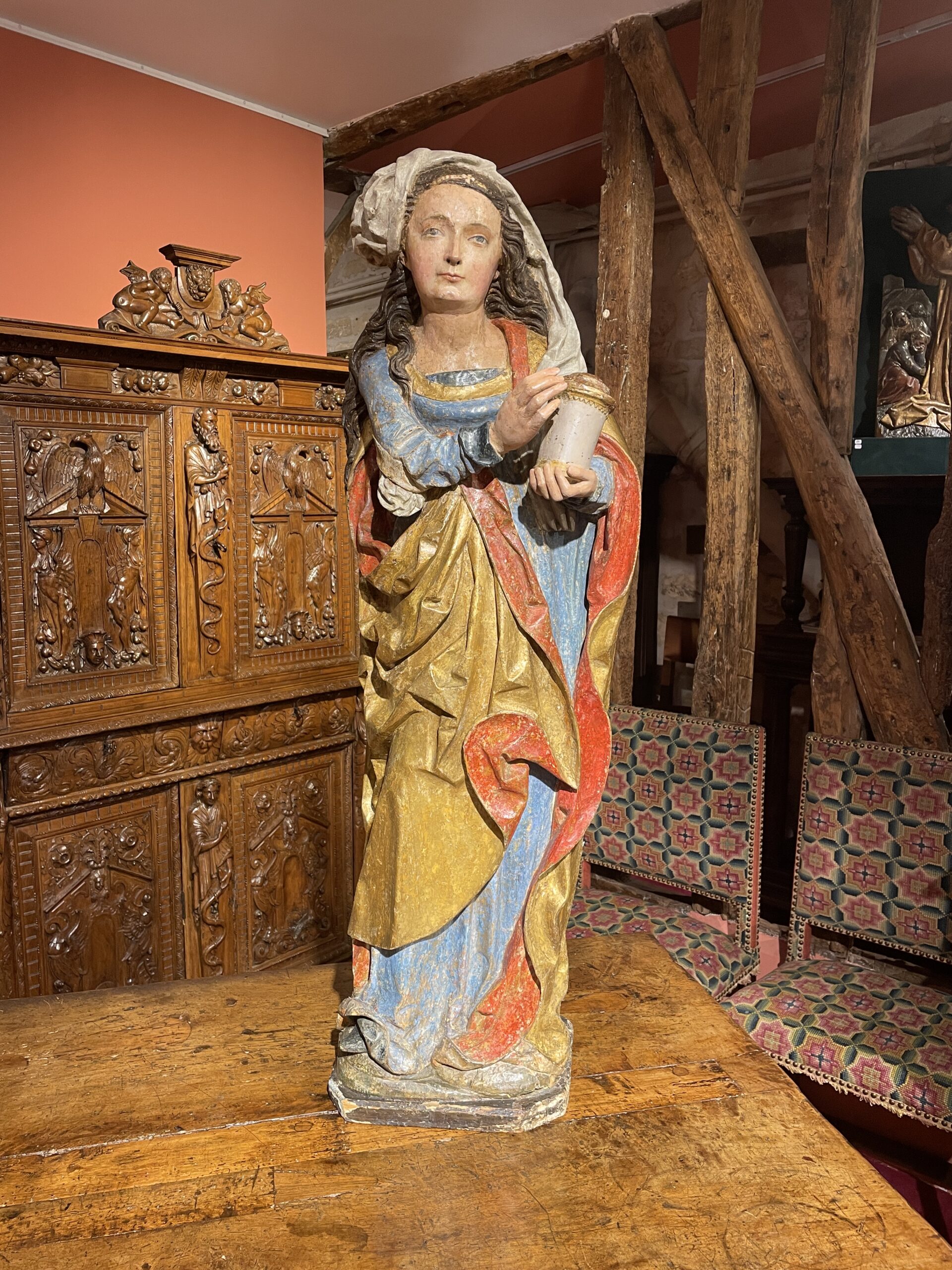
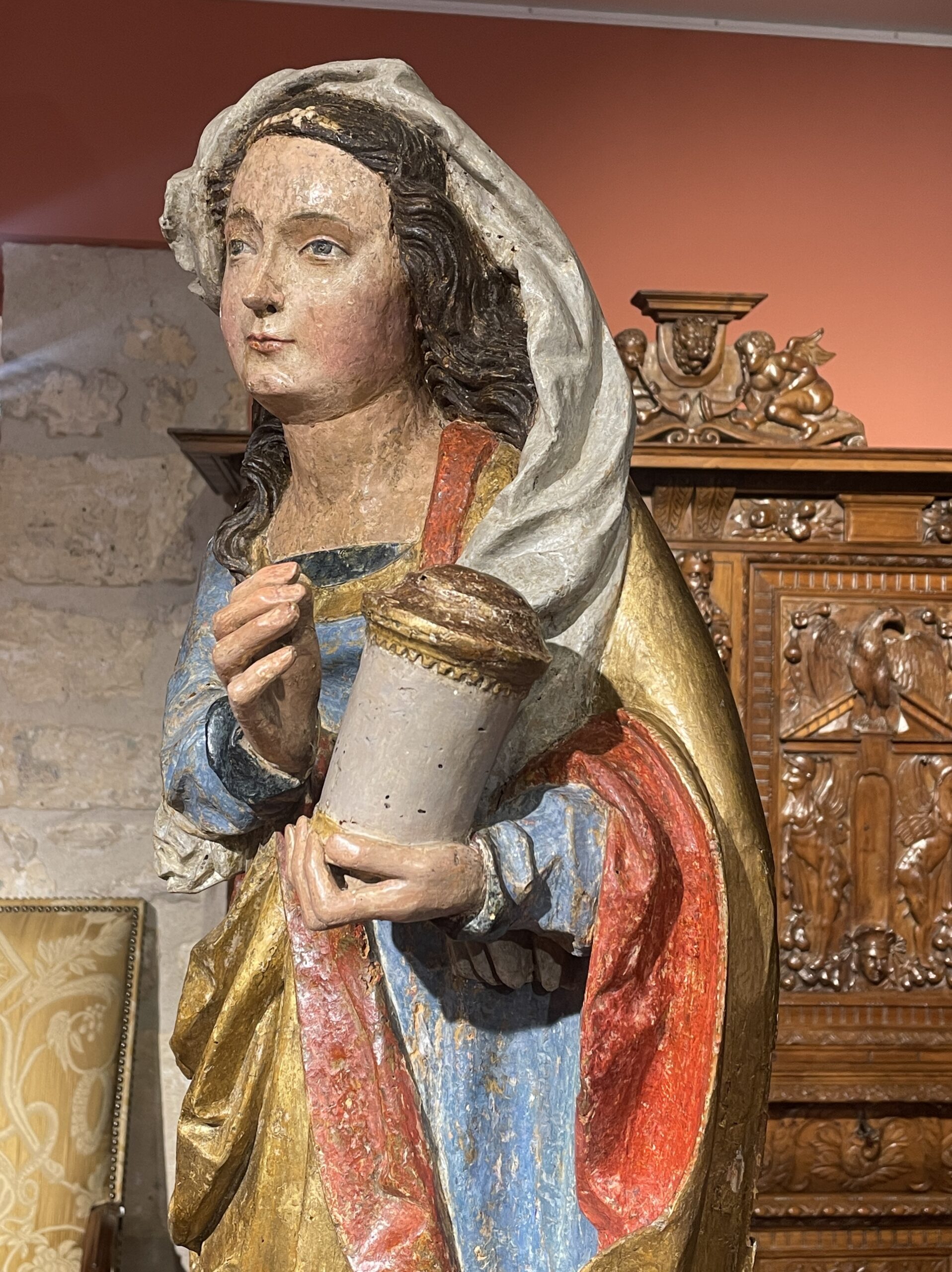
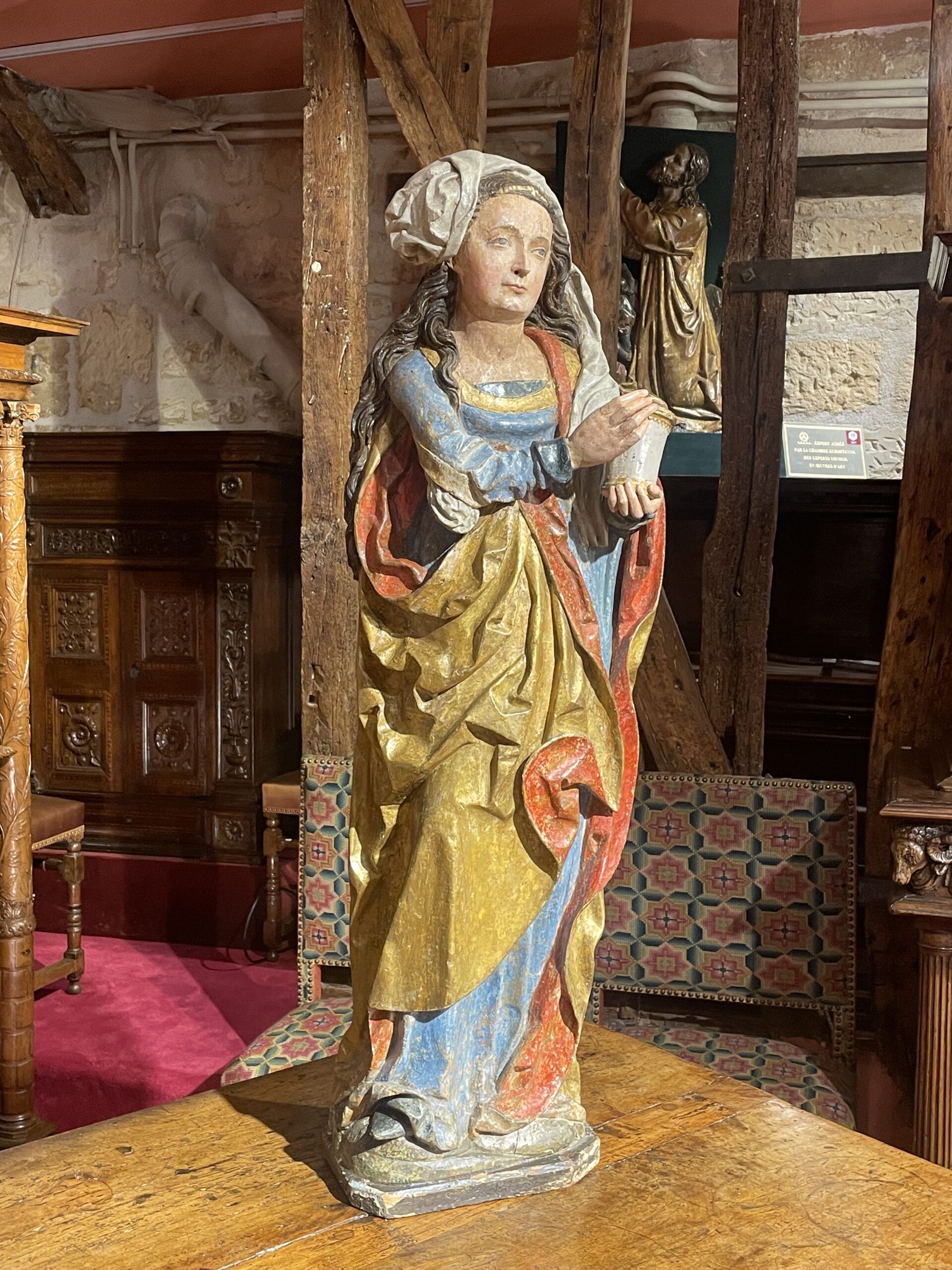
Traditionally depicted with an ointment jar, Mary Magdalene is described as a myrophore, one of the Holy Women who brought perfumes to Christ’s tomb.
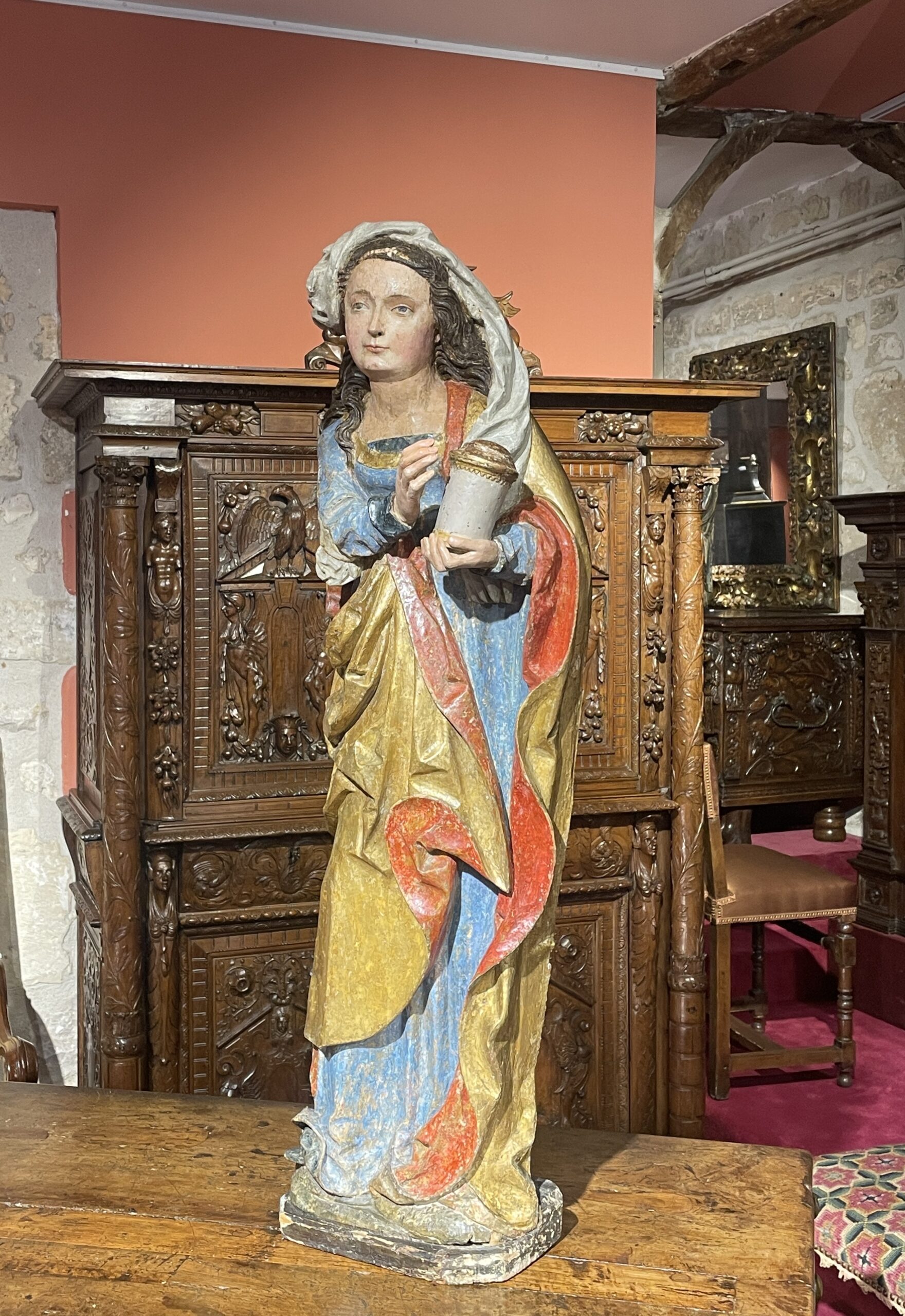
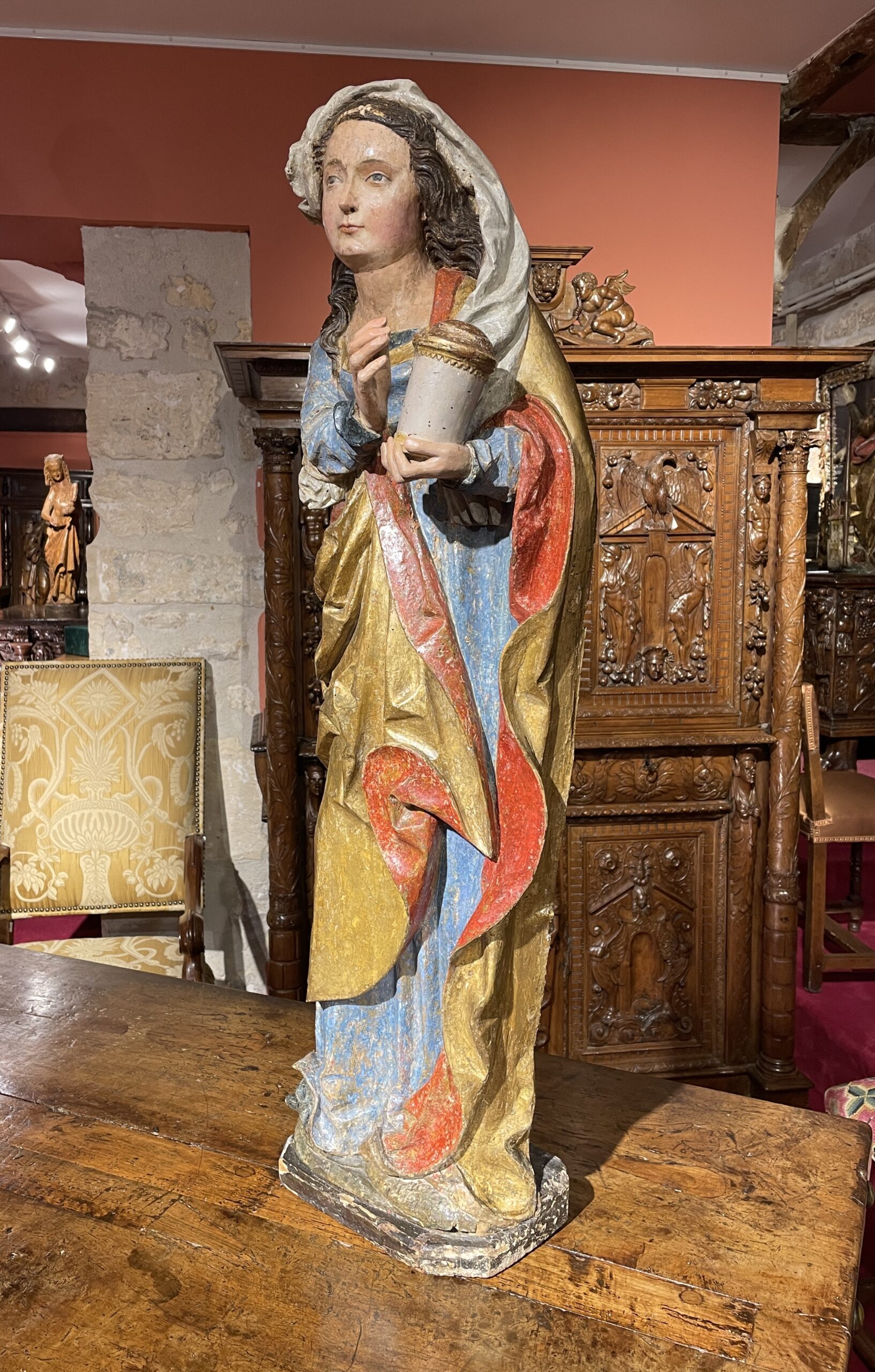
This sculpture portrays a youthful Magdalene with long flowing hair, her delicate features marked by a pensive, melancholic expression. Her fine lips and small dimpled chin add to the refinement of her face.
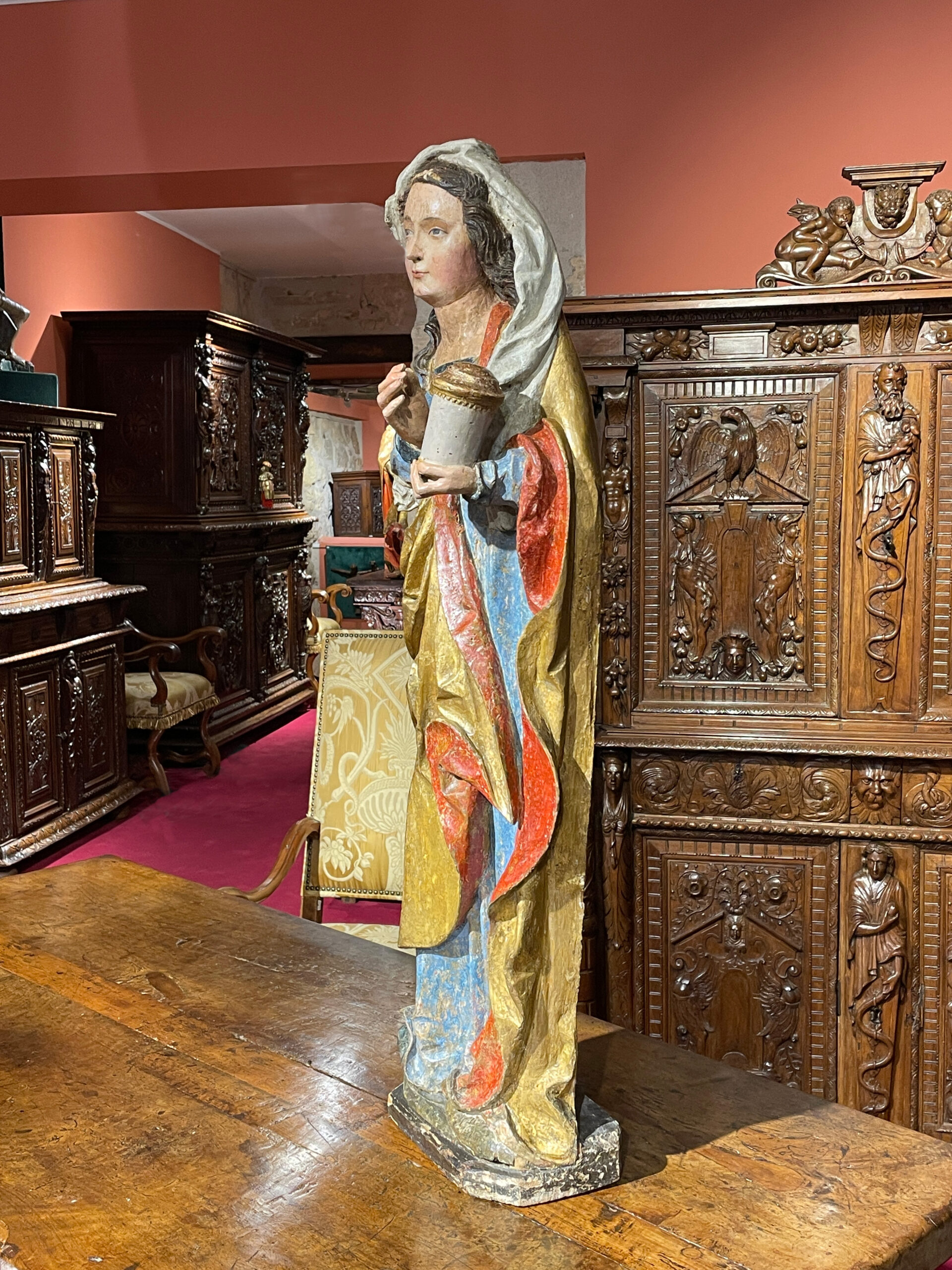
She stands upright, richly dressed in vibrant colors, holding the ointment jar in her left hand. She wears a long gown with a rounded neckline and a heavy mantle with deep, prominent folds, the edge of which she gathers with her right arm. Her long wavy hair is tied with a narrow ribbon adorned with a discreet clasp. The lyrical sweep of her veil echoes the movement of her cloak.
Luminous and imbued with spirituality, this Mary Magdalene is characteristic of late 15th-century Franconian sculpture, as noted by J. Boccador in Statuaire médiéval de Collection :
« The polychromed wooden Magdalene from the Bresset collection directly reflects the expressive art of the Nuremberg school.
Her face, of great nobility and deeply human, conveys the spirituality of works attributed to Master Wit.
The ethereal movement of the cloak’s drapery, still treated with elegance, remains fully within the style of Wit Stosz and his school.
These various elements allow us to place this beautiful Magdalene in Franconia, toward the end of the 15th century. »
Bibliography :
J. Boccador et E. Bresset, Statuaire médiévale de collection, T II, p. 270-271, ill. 284.
BOCCADOR TEXT BOOK ABOUT THIS MARY MAGDALENE SCULPTURE
It is worth recalling, regarding this Mary Magdalene from the finest period of the Spätgotik (Late Gothic), that while France was being won over by the spirit of “ease,” Germany, on the contrary, was revitalizing medieval art, deliberately opposing the Humanism of the Quattrocento.
Spätgotik is, in fact, an art form inseparable from its Germanic origins and cannot be applied to any other school. This late Gothic style represents a reactionary, specifically German art which, while absorbing certain humanist ideas, redirects them against the current, using them in the service of a realist expression of human dignity, in both its greatness and its suffering. It embodies a medieval humanism in which every dimension of human existence — life and death — is placed in the service of an intense expression of faith.
Guided by a relentless pursuit of perfection, German sculptors — first and foremost master builders — achieved extraordinary technical mastery. Their chisels, especially in wood, but also in stone (as with Tilman Riemenschneider), rendered with remarkable delicacy even the subtlest details of a face or a hand. Most of these sculptors painted their works themselves, attaining the same refinement of expression as painters.
With Spätgotik, sculpture reached the most delicate nuances of portraiture, previously reserved for painting.
Tilman Riemenschneider, who left his sculptures in their natural wood without polychromy, shocked his contemporaries. Yet the nervous energy and subtlety of his faces rivaled painting through the play of light and shadow on the carved wood.
If Colmar had Schongauer, Strasbourg had Nicolas Gerhaert; Augsburg, Holbein the Elder; Constance, Conrad Weit; and Dürer spread his genius over all Germany, Franconia became home to a constellation of Spätgotik masters — Wit Stosz (Veit Stoss), known as Master Wit of Nuremberg, Kraft, and at Würzburg, Tilman Riemenschneider.
Wit Stosz, heavily influenced by Nicolas Gerhaert (the successor of Claus Sluter) and the engravings of Schongauer, excelled in abundant detailing and intense facial expressiveness, achieving extraordinary emotional range. Master of the famous Kraków altarpiece (11 meters wide and 13 meters high), he left his mark on Nuremberg with statues for the churches of Saint Sebald and Saint Lawrence, and completed the Bamberg triptych at the end of his life. Painter as well as sculptor, he always completed the polychromy of his works himself. Carried by the fervor of his expressionism — whose realism captures the most fleeting moments of human spirituality — he occasionally verged on mannerism in drapery, though never in figures or faces.
Tilman Riemenschneider, a few years his junior, accustomed to working in both stone and wood and influenced by the sharp pictorial style of Albrecht Dürer, maintained — even at the height of Spätgotik — a stylized treatment of fabric and a noble restraint in faces. Unmoved by mystical atmospheres or dramatic mystery plays, he distinguished himself by the modesty and dignity of his figures and their technical perfection. His Creglingen altarpiece (ca. 1505), over seven meters high and 3.5 meters wide, stands as a defining example of his monumental and balanced art.
German art of the late 15th century produced a series of monumental altarpieces that, unlike their Flemish counterparts, were never exported.
The polychromed wooden Magdalene from the Bresset collection directly reflects this expressive art of the Nuremberg school.
Her face, of great nobility and deeply human, expresses the spirituality characteristic of Master Wit’s works.
The ethereal movement of her mantle, treated with elegance, remains entirely in keeping with Franconian sculpture in the circle of Veit Stoss and his followers.
These elements together allow us to place this exceptional Mary Magdalene in Franconia, toward the end of the 15th century. The Bayerisches Nationalmuseum in Munich preserves another Magdalene of comparable craftsmanship, carved in limewood, but smaller (42 cm). She is also dressed in the fashion of noblewomen of the period and, while her facial morphology is similar, her passive and sorrowful expression differs markedly from the vivid spirituality of the Bresset Magdalene.