



Description
Context
During the Second Renaissance, the art of furniture design tended, in variously rigorous ways, to model itself on the architectural system inherited from antiquity via Quattrocento Italy.
This system was based on a principle of mathematical proportion and regulated each part of the building by reference to a basic conventional unit: the module.
At the same time, Renaissance men discovered the power of man over an objective world in his own measure. And it is precisely this measure that the architect was tasked with introducing by revealing the connections between man and the world.
The particularity of Lyon lies in the fact that it does not analyze classical architecture in the same way as other places, such as in the works of Du Cerceau or Jean Goujon, for exemple.
Lyon furniture takes from architecture, above all, principles of organization and rigor in the distribution of masses, frequently neglecting architectural emblems such as the pediment or the columns.
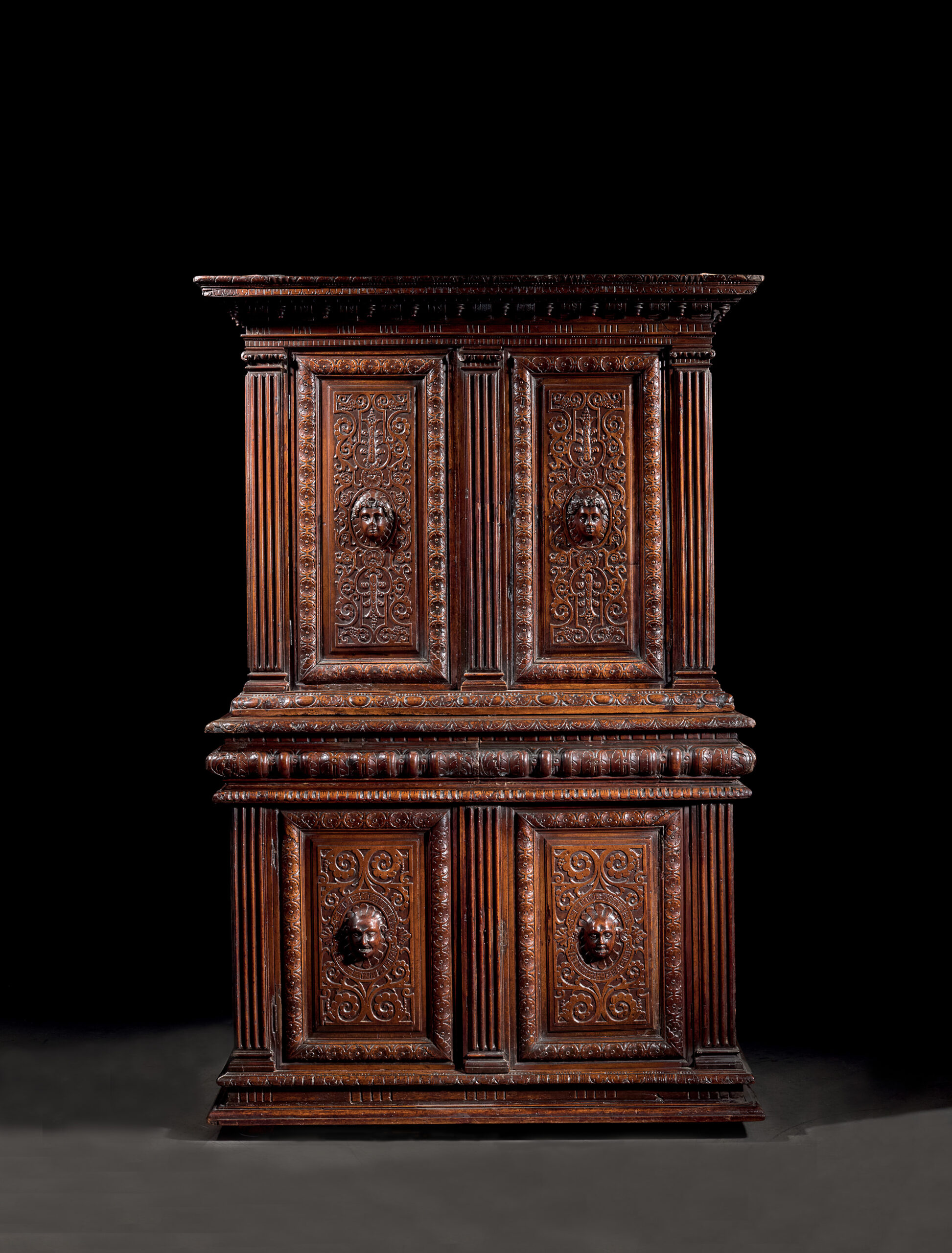
This exceptional cabinet is typically characteristic of the works carried out in Lyon during this Second Renaissance. While the fluted pilasters are precisely integrated into the uprights, their panels give rise to a fantastical life in which macaroons and masks mingle in an intensely worked vermiculated setting.
Description
This piece of furniture with two superimposed bodies and a very slightly recessed upper body presents on the front and sides a rich ornamentation of remarkable quality of execution, some elements of which are particularly rare.
The Upper Body
The well-structured Cabinet, with its slender upper body, adopts a triple rhythm with its fluted pilasters framing the finely crafted doors.
The ornamental richness of the overhanging cornice sets the tone for the entire Cabinet. The stylistic refinement and fine workmanship excel right up to the very top.
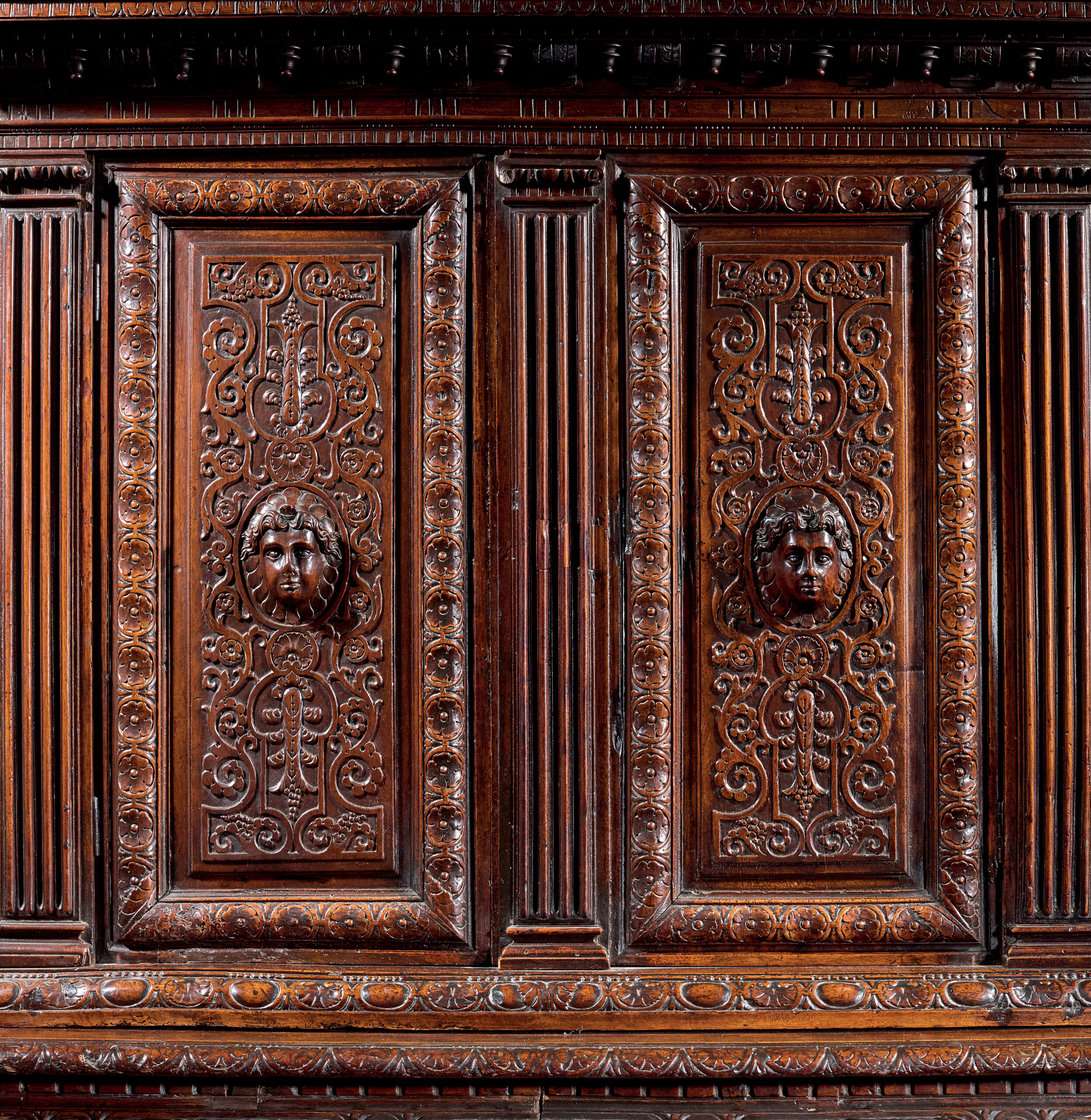
We find a series of juxtaposed friezes. An alternating frieze of lotuses and lunulas overhangs a beaded frieze, then one adorned with scales and claws. Below the cornice, beneath a dentil frieze, spinning tops oscillate with consoles adorned with palmettes, followed by two sets of glyphs.
Between the fluted pilasters with Ionic capitals adorned with an egg placed on the uprights, the two doors, with a roundly molded panel and a frieze of rosettes, offer a rich vermiculation decoration. From the fine, leafy scrolls, florets, bunches of grapes and Burgundy cabbages escape. The themes of abundance and fertility are also skillfully illustrated.
In the center of the left panel, as if emerging from a medallion, a female portrait is depicted in a beautiful bas-relief. On the right panel, a male portrait appears. This is likely a representation of the couple who received this piece as a gift.
The base of the upper section features a beautiful frieze of discs and palmettes.
The lower Body
The apron, flanked by beautiful acanthus leaves, features two drawers adorned with rich gadroons, sometimes with palmettes.
The lower section, more compact in its structure, echoes the same theme as the upper one. At the center of each panel, adorned with carved leather and leafy scrolls, stands a beautiful mascaron with a strong expression in high relief.
The Sides
The refinement of this piece also comes from its sides, which extend the gadroon decoration and the vermiculation decorations, treated flat with the same density, verve, and richness of detail.
This rare walnut wedding cabinet with its beautiful patina is a fine example of Lyonnais production from the mid-16th century, combining harmonious proportions with beautiful bas-relief carving covering the entire surface of the panels