



Description
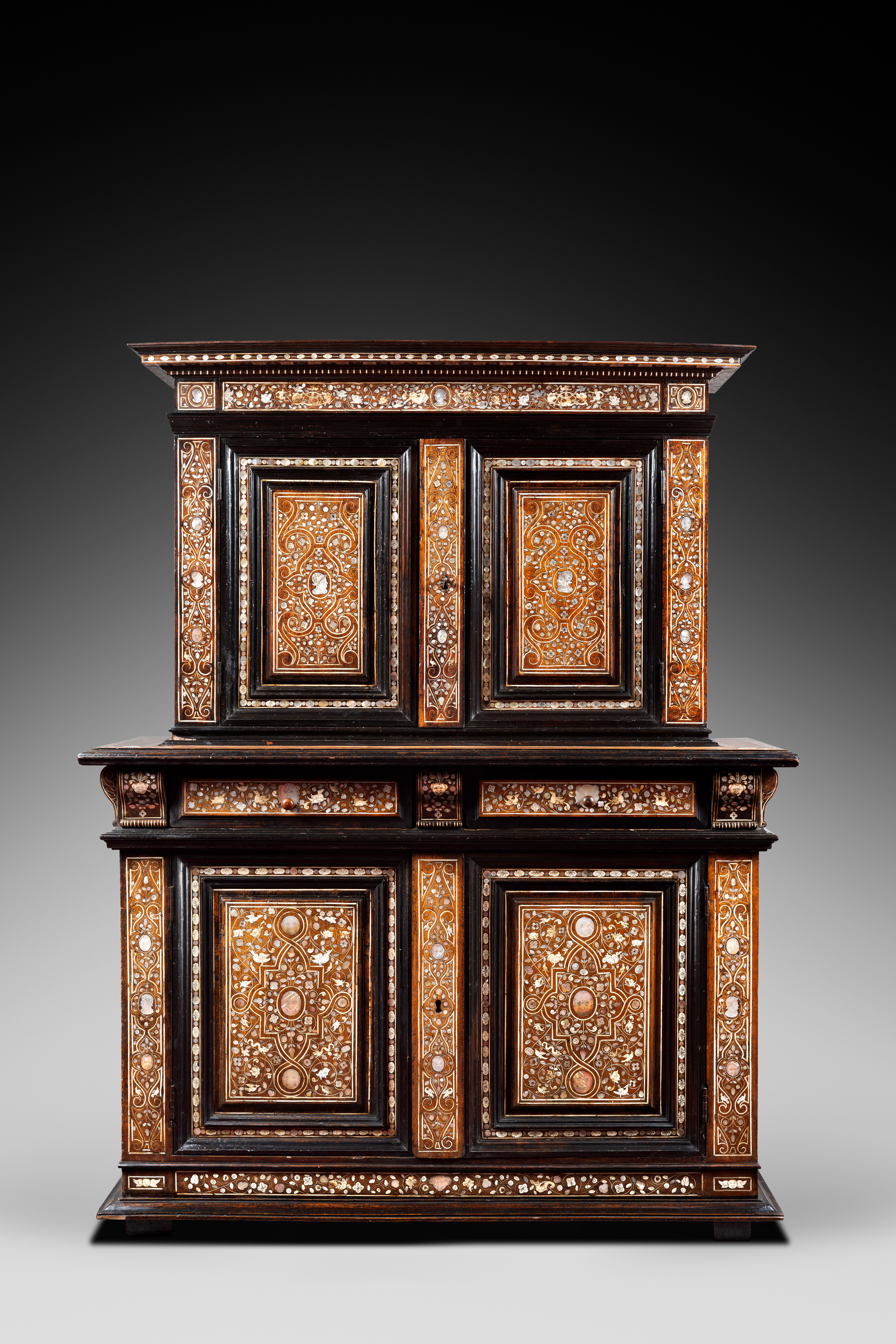
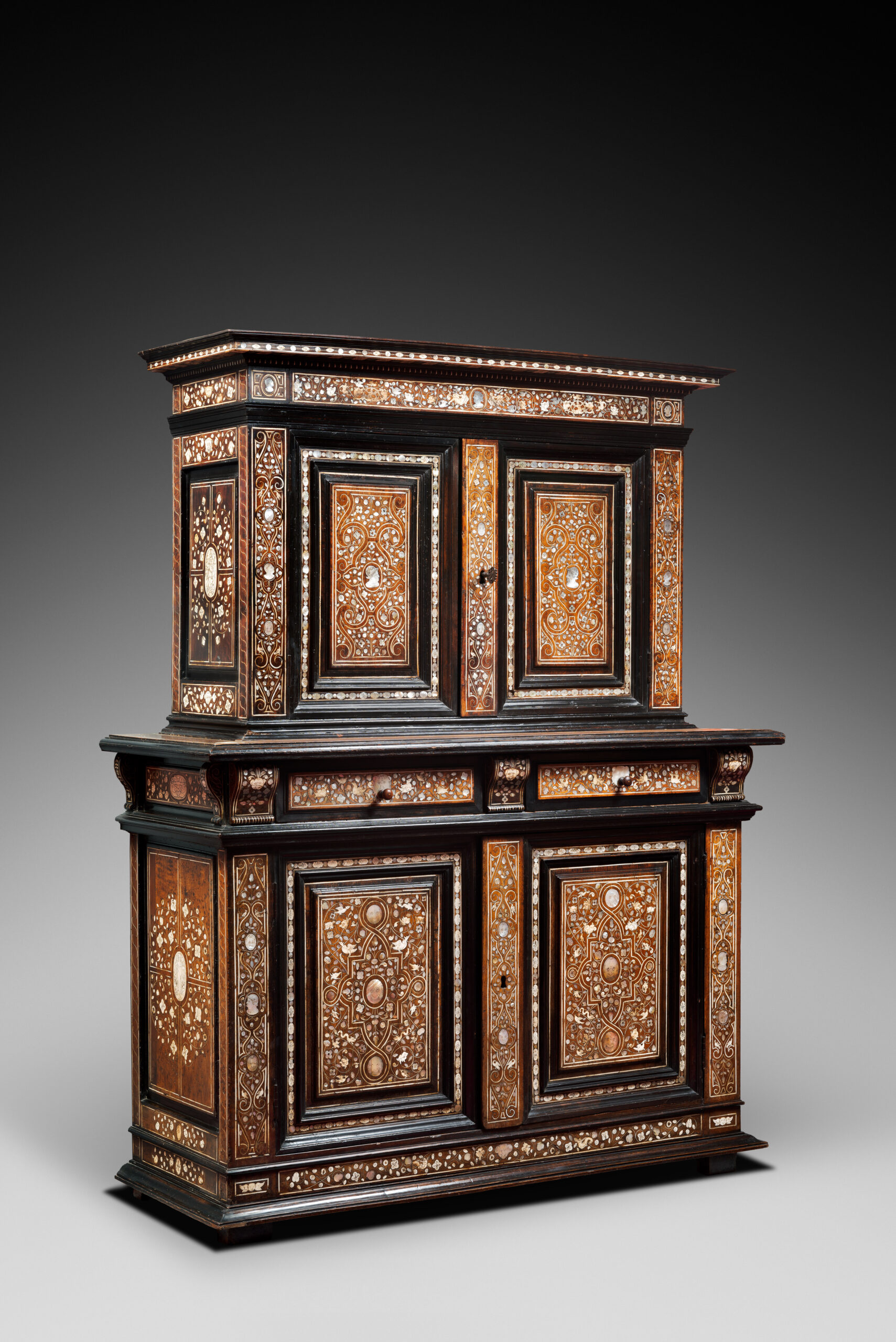
This two-bodied cabinet shows harmonious proportions and opens with four door-leaves and two drawers in the belt.
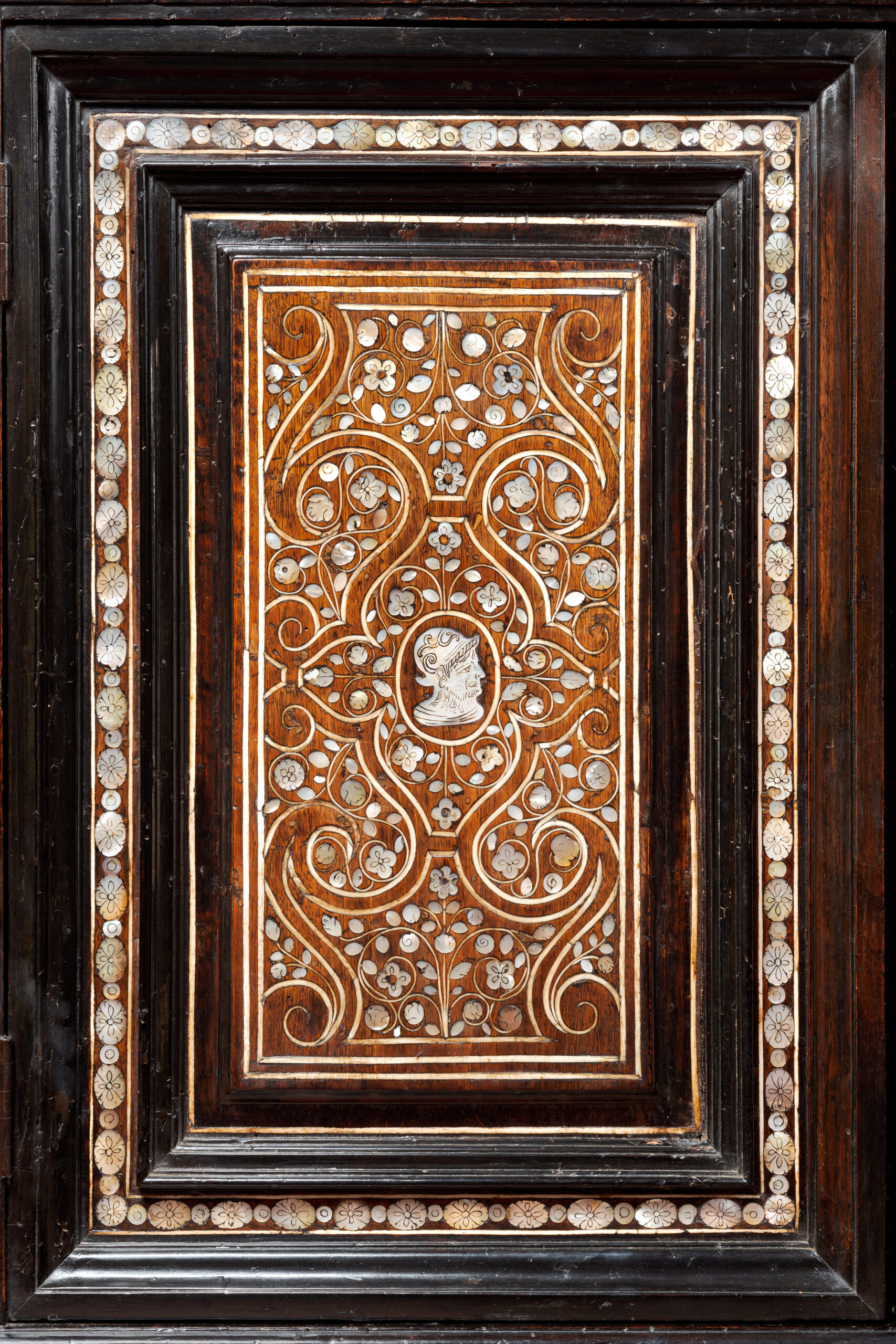
Mother-of-pearl and ivory inlays draw an elegant network of lines and scrolls inhabited by birds, figures, fantastical creatures, masks, and medallions displaying the profiles of kings and helmeted soldiers.
The lower body stands on a low moulded base. A frieze presents delicate scrolls springing out of the mouth of a mask with ram horns. They are accompanied by flowers and putti.
On the lateral and the central jambs ivory lines structure the composition as frames and cartouches. Stems spread around three superimposed mother-of-pearl medallions engraved with the profiles of men and wincing masks.
The decor of both door-leaves on the lower body are centred by a mask around which symmetrical scrolls spread in foliated stems with flowers and animals. The presence of those creatures animates the composition. The panels comprise a moulded frame enriched with a flowery frieze.
The belt’s three drawers are divided by three consoles showing a heeled profile. They are adorned with vegetal motifs surrounding a mask while the drawers present the same decor as on the rest of the cabinet.
Each door-leaf of the upper-body is centred with a mother-of-pearl medallion meticulously carved with the profile of a helmeted soldier. A lush decor of supple foliated stems fills the panels. Ivory lines trace loops and scrolls.
On the elongated surface of the entablature the frieze runs symmetrically on both sides of the central mother-of-pearl medallion showing a crowned king. The decor is more complex than on the rest of the cabinet. Amongst the foliated and flowered stems are playing fantastical creatures and birds. Two reclining female figures frame the central medallion.
Mother-of-pearl scrolls also adorn the sides of the cabinet. They spread in concentric circles around an oval ivory medallion. In the lower part appears a naked winged young man, perhaps Cupid, a divinity associated with love, while on the upper part, the man wearing an armour and leaning on his spear could be Mars, the Roman god of war. Those compositions are more airy and rigorous in their geometrical aspect.
The top is inlaid with masks in its angles.
In the first half of the 17th century, alongside some of the great European furniture producers, a few rare Italian furniture artisans, particularly Venetians, managed to create their own styles, often still clearly influenced by the Baroque spirit of the previous century and the more distant Renaissance.
The Rare Cabinet presented here fits into this specific context. Its marquetry decoration, with inlaid ivory and mother-of-pearl motifs, illustrates one of the most original and elaborate creations of Italian cabinetmaking of the period.
This type of Venetian furniture was first studied in detail by Alvar Gonzales-Palacios in his work Il Gusto dei Principi, Arte corte del XVIIe e del XVIII secolo (Milan, 1993, vol. 1 p. 336 and vol. 2 p. 297, fig. 592). The author wrote an essay aptly titled “A Venetian Mystery,” in which he attempts to link this type of furniture, as well as a set of inlaid chests, made in the same spirit, to a Venetian workshop active during this period and still anonymous.
This set of furniture shares common characteristics, particularly in the treatment of the marquetry decorations inspired by oriental motifs, European motifs, and even southern German motifs through hunting scenes (see: the chiseled and engraved Germanic crossbows), or contemporary engravings.
Exceptional for its extremely fine quality and its mother-of-pearl and ivory inlay decoration, this cabinet is an excellent example of the virtuosity of intarsia work in Italy. The sumptuousness and elegance of these compositions reveal a highly talented ornemanists.
The curves and scrolls of the arabesque decoration gracefully soften the architectural rigor of this Cabinet. The sumptuousness of the decoration and the luxury of the materials combine to create this cabinet and attest to a high-ranking commission. Indeed, this type of furniture was intended for prestigious clients.
This cabinet is an exceptional testament to the expertise of Venetian cabinetmakers and ornamentists of the early 17th century. Its substantial dimensions, sumptuous inlay decoration, and perfect state of preservation make it an exceptional piece of furniture.
Bibliography :
Alvar Gonzales-Palacios , Il Gusto dei Principi, Arte corte del XVIIe e del XVIII secolo, Longanesi & C, Milan, 1993.