



Description
The canonical Gospels briefly describe the Nativity episode.
This event consists of three parts:
– The Prelude: the journey to Bethlehem, the census
– The Nativity
– And the Announcement to the Shepherds and the Adoration of the Magi.
Only the Gospel of Matthew (2:1-12) mentions the Adoration of the Magi. While it remains vague about their number, names, or origins, it does indicate that they presented the newborn with gold, frankincense, and myrrh. The apocryphal texts, the Church Fathers, and many other authors filled in the gaps of the Gospel account. The sobriety and symbolism of this narrative also left great freedom for interpretation by artists.
Although the earliest representation of the Adoration of the Magi dates from the 2nd century, this theme became one of the most popular in Christian art from the late 14th century. Its appeal to artists was partly because it allowed for the celebration of both the Virgin and Christ.
The two relief panels depict the various stages of the Nativity story.
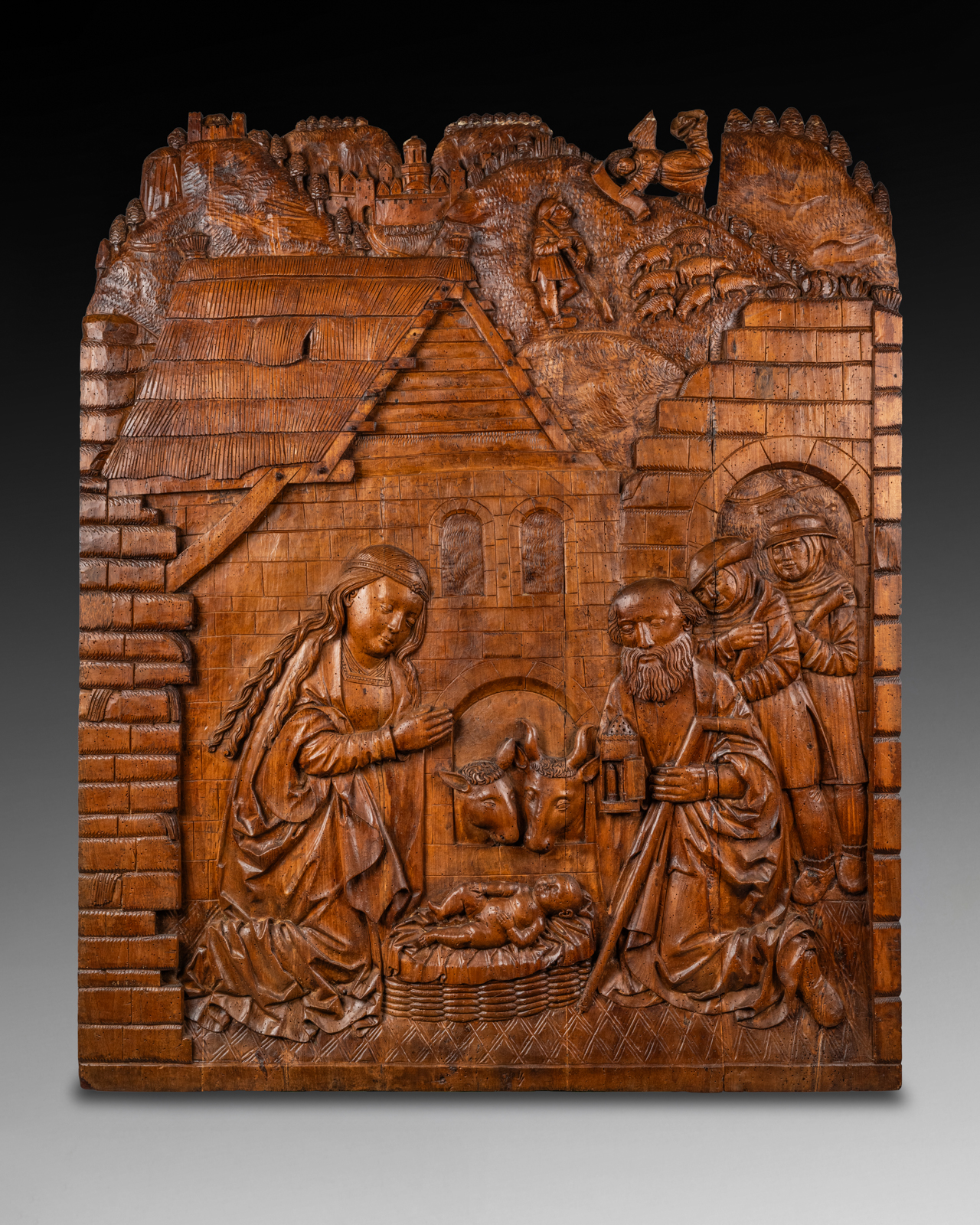
The Nativity and the Announcement to the Shepherds
Under a thatched roof, the donkey and ox, who accompanied Mary and Joseph to Bethlehem, surround the divine child placed in a woven basket. The Virgin, with long, wavy hair, is kneeling while Saint Joseph is by her side. Dressed in his pilgrim’s robe, he holds a lantern to light the scene, with the candle symbolizing the divine presence.
Two shepherds enter through the arch behind Joseph.
This scene is accompanied by a detailed and narrative background. In the upper part of the panel, a shepherd receives the Announcement of Jesus’ birth. An angel descends from the sky, holding a scroll with the good news, while the sheep graze beside him. In the background, the fortified city of Bethlehem is outlined. Stylized fir trees adorn the hilltops.
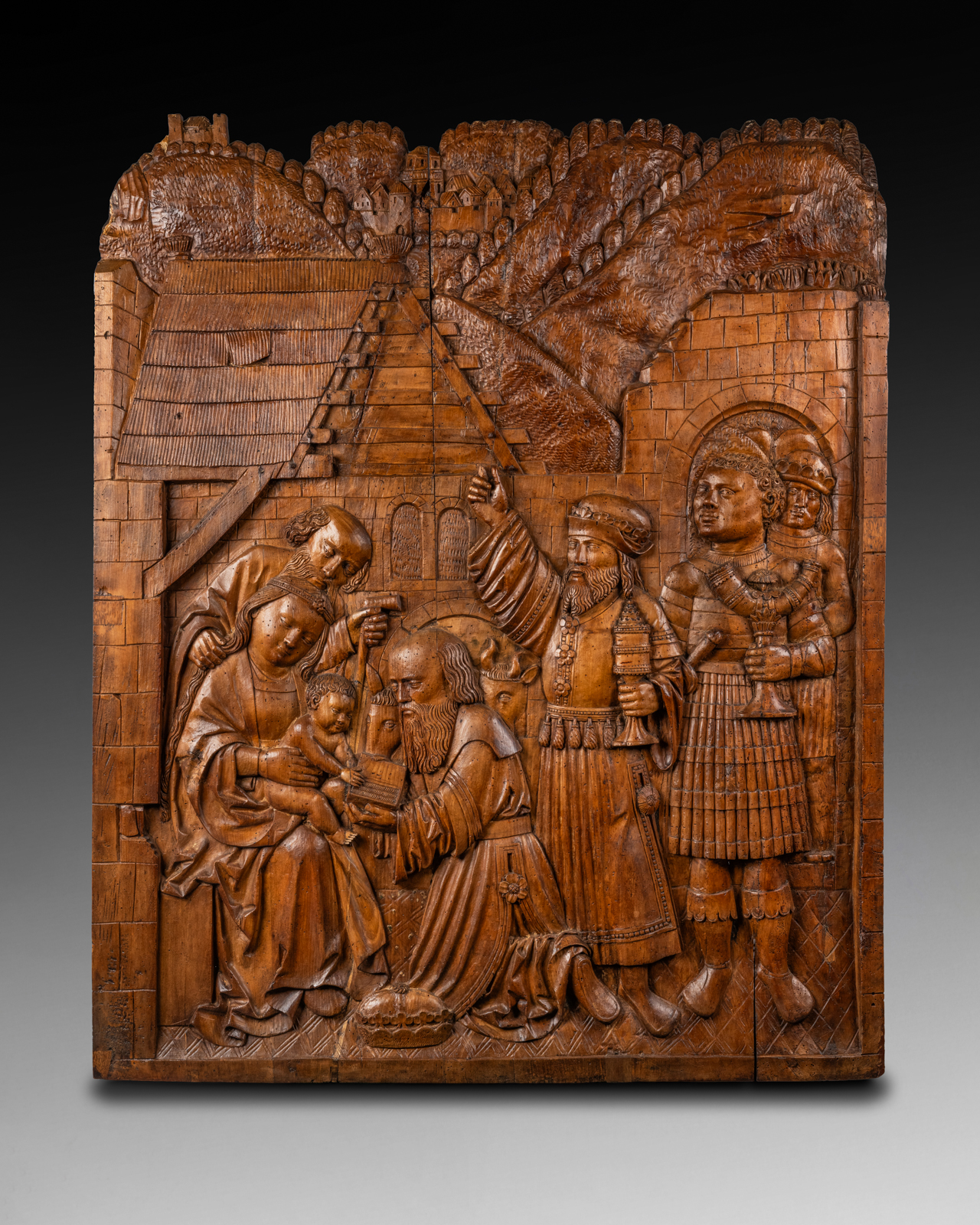
The Adoration of the Magi
Before the Holy Family, the three Magi follow one another, coming to pay homage to the newborn.
The first Magus has a pointed beard. He has already knelt as a sign of respect and has placed his crown at his feet. He presents the divine Child with a box filled with gold coins. This is Melchior, whom legend describes as an old man with white hair and a long beard.
Gaspar, the second Magus, carries a cup containing incense. With his right hand, he points to the third and final Magus, indicating the star that guided them here. He has a fine beard. He wears a doublet with particularly wide sleeves and pointed shoes.
Finally, Balthazar, the last Magus, hurries towards his destination, his right hand on the hilt of his sword and a cup in the other. He moves proudly, dressed elegantly, towards the Holy Family, bringing myrrh to the divine Child.
This low-relief panel is the work of a very skilled and imaginative artist. This pivotal moment of the New Testament is transposed into a contemporary context, thanks to the attire of the characters. Thus, the universal nature of the scene is enhanced, making it easier for contemporaries to understand.
Notable are the nobility of the postures and the elegance of the garments, with well-structured pleats. The iconographic repertoire, the quality and refinement of the carving, combined with the intelligence of the composition, make it a fine example of early 16th-century German sculpture.
Bibliography :
Louis Réau, Iconographie de l’Art chrétien, II/2, Presses Universitaires de France, Kraus Reprint, Millwood, 1988.