



Description
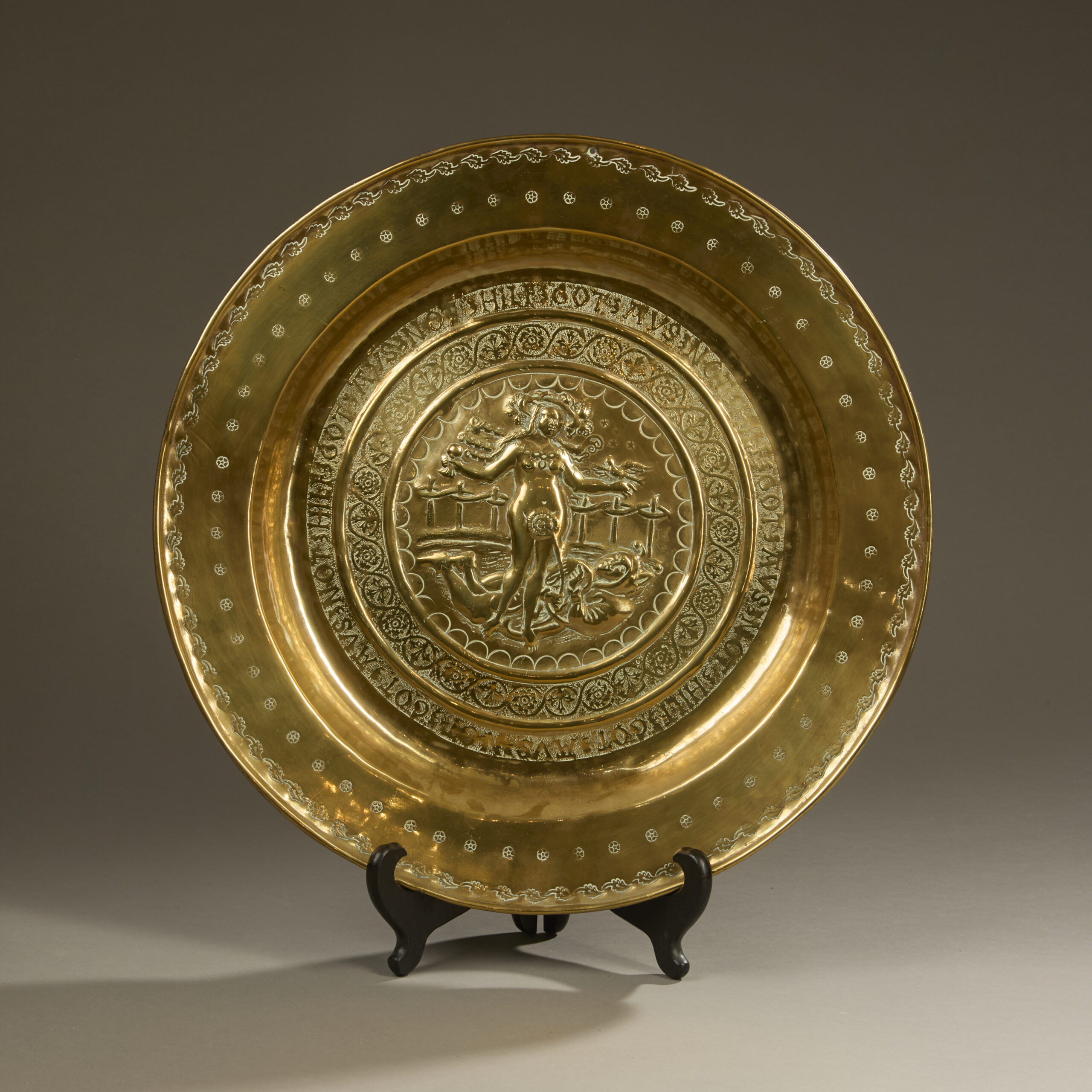
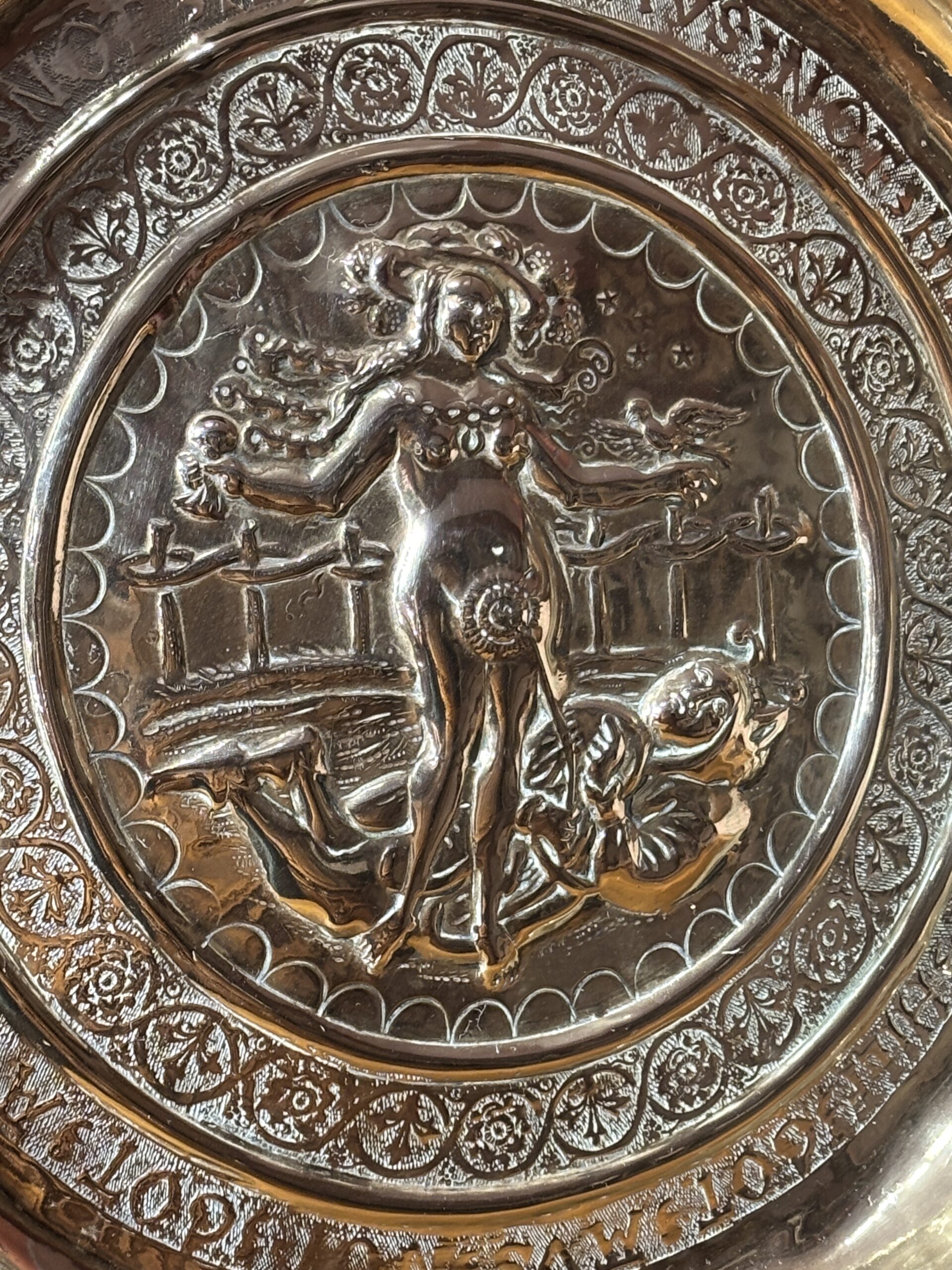
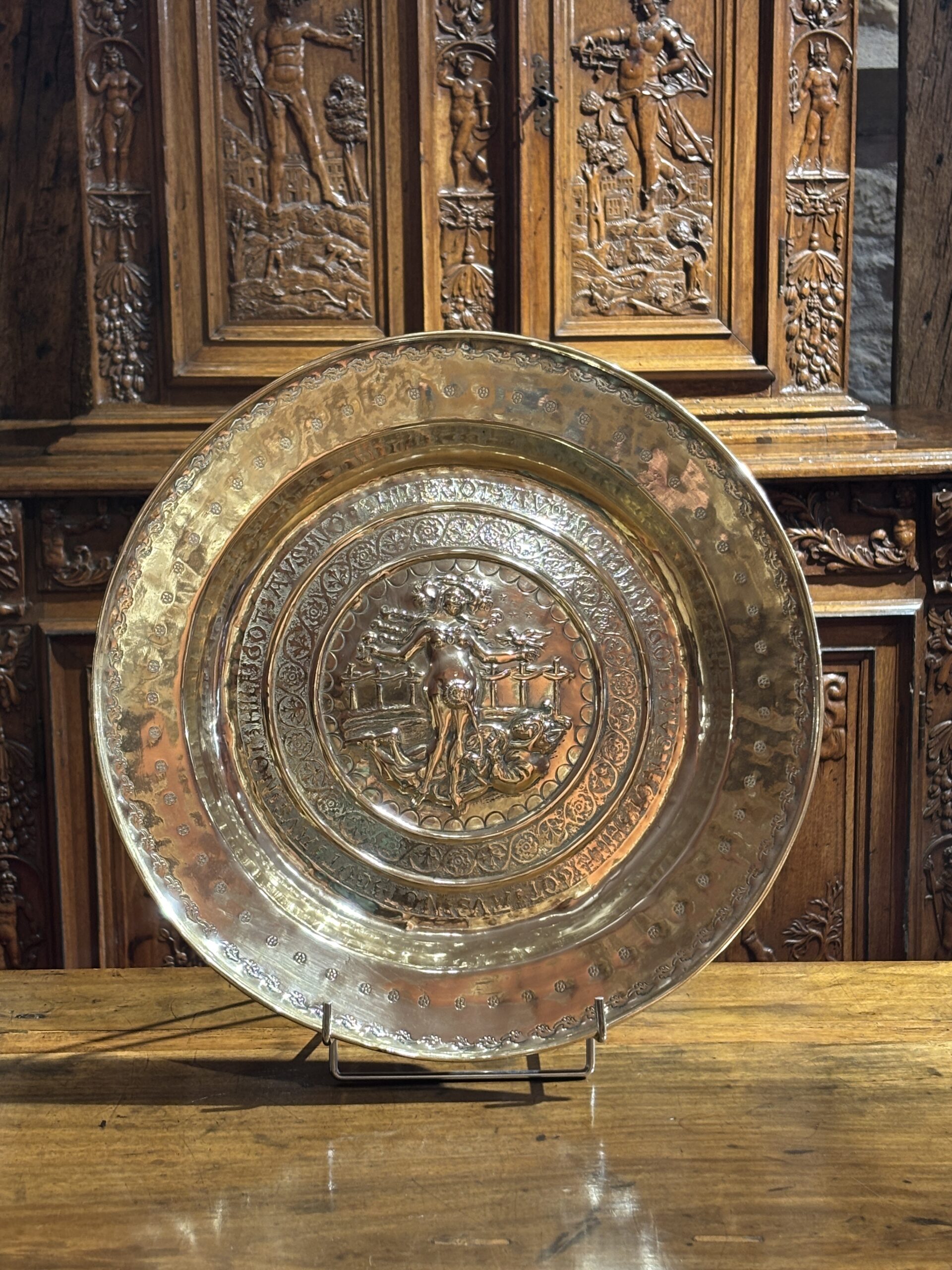
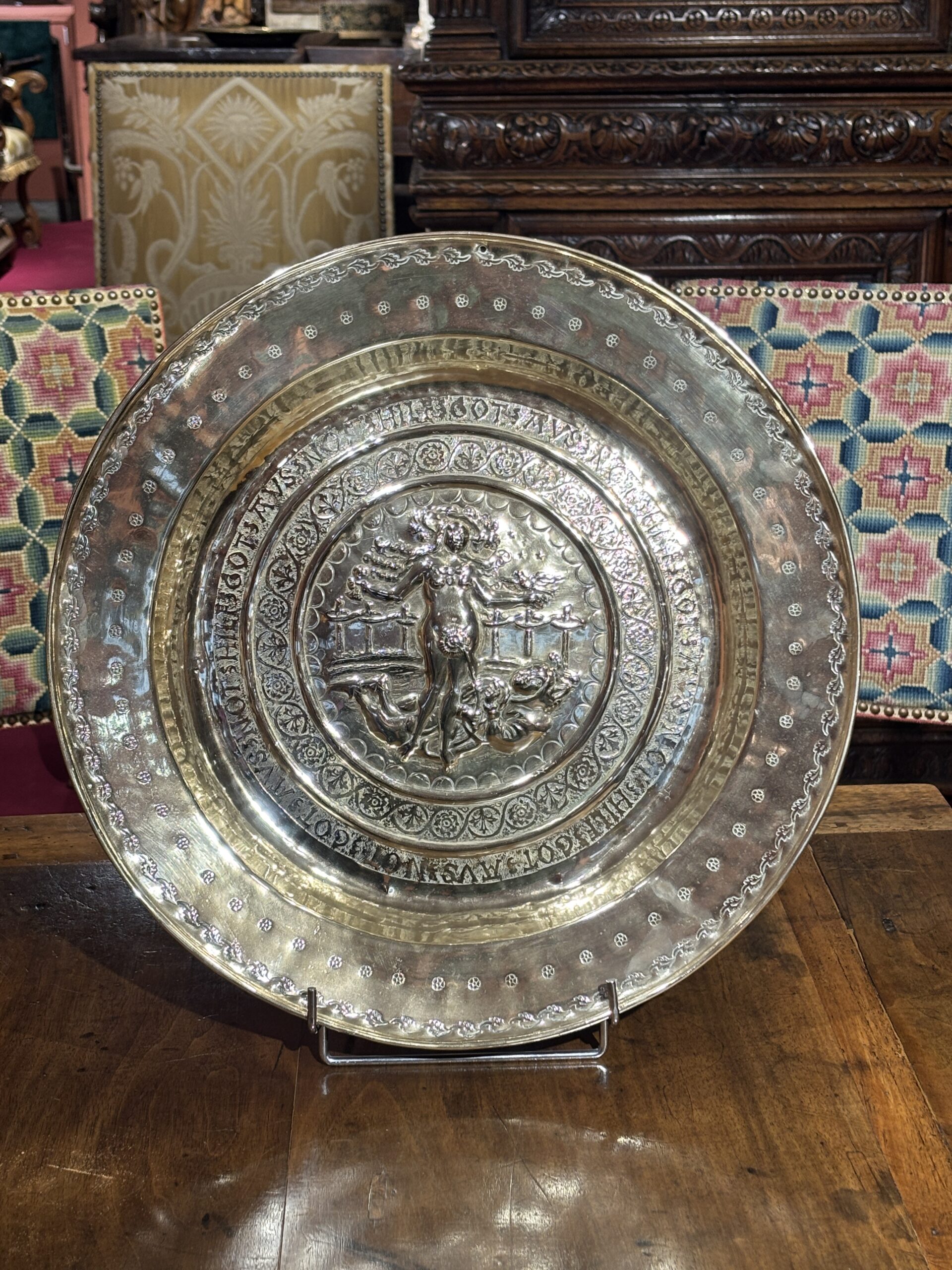
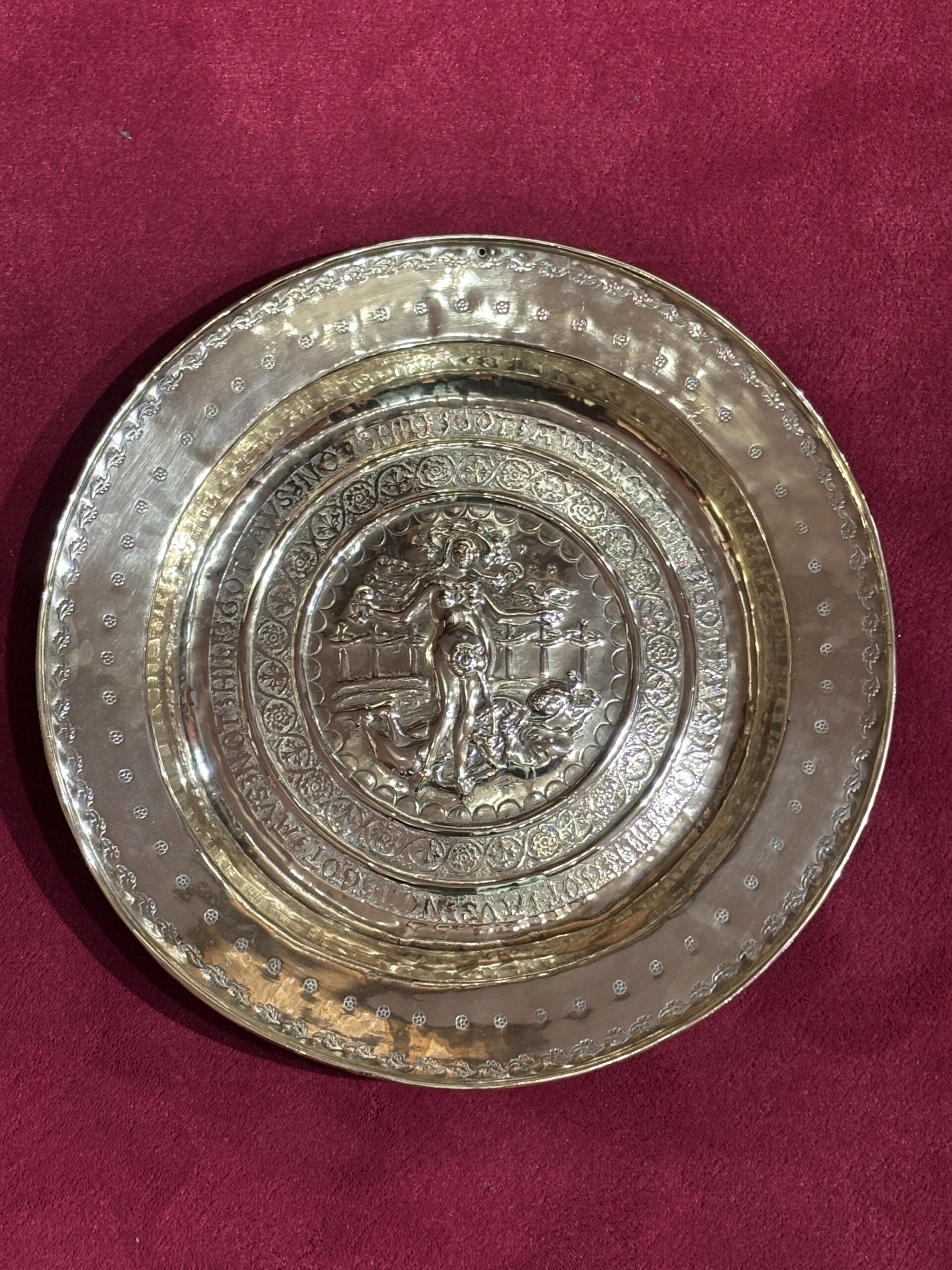
This embossed, punched, and engraved brass offering dish depicts the Courtesan and the Fool.
The slightly raised rim is bordered by a punched frieze of palmettes and a row of floral motifs, while the marly is left plain.
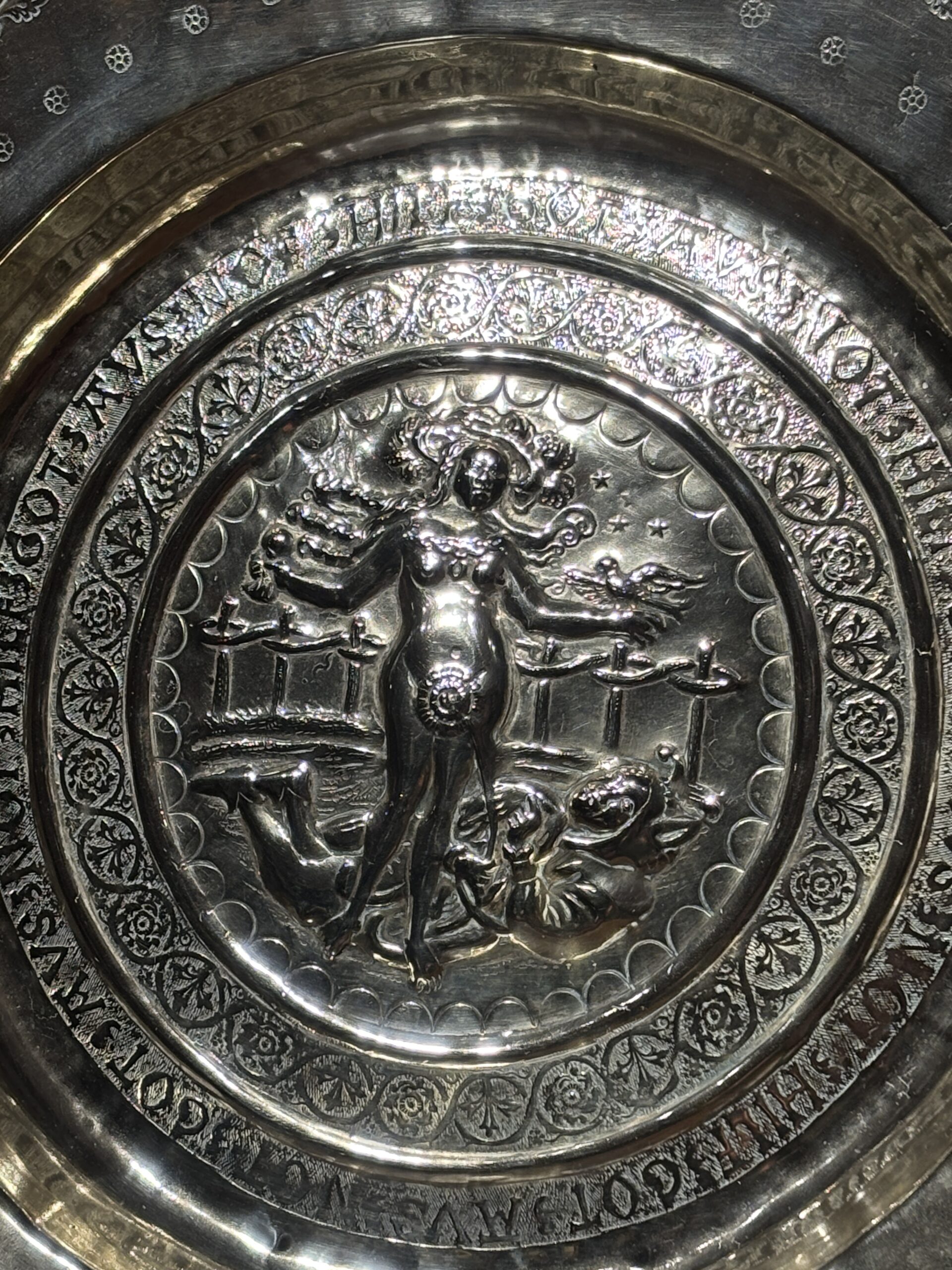
The well is decorated with two concentric bands separated by a raised fillet. The inner band bears the inscription “HILF GOT AUS NOT” (“May God help us in times of distress”), while the outer band is ornamented with a frieze of interlaced scrolling foliage alternating with floral and trefoil motifs.
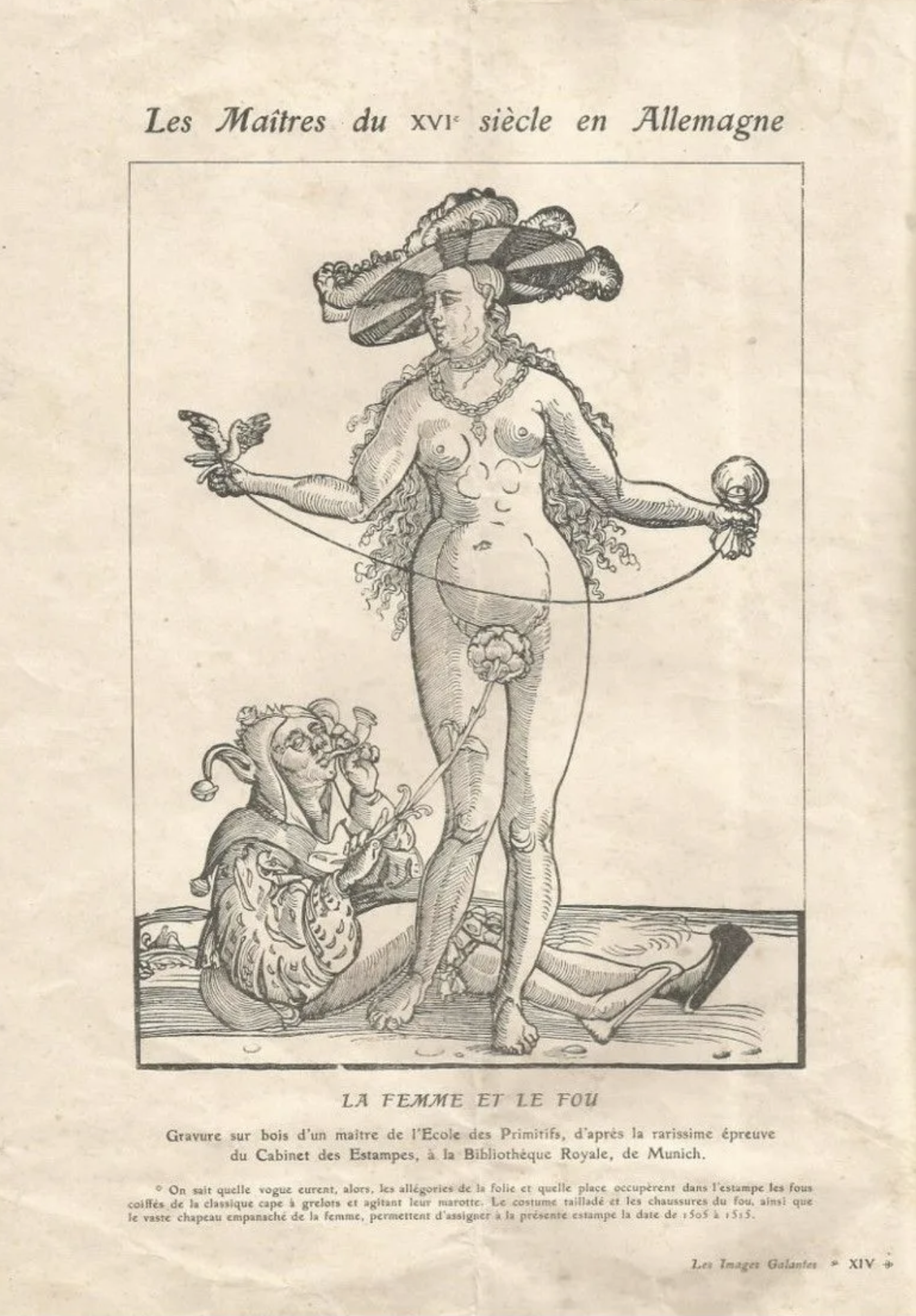
The central medallion, enclosed within a festoon border, depicts an orchard landscape beneath a starry sky. Standing within it is the figure of a nude woman whose only attire consists of a hat adorned with a garland of feathers. A cuckoo perches on her left hand, while in her right she brandishes a baby’s rattle in the form of a pacifier enclosing a small bell. At her feet lies a fool dressed in a hooded tunic, holding the long stem of a rose whose blossom both touches and conceals the woman’s genitals.
Bibliography :
– E. Antoine-König & P.-Y. Le Pogam (dir.), Figures du fou. Du Moyen Âge aux Romantiques [catalogue de l’exposition présentée au Musée du Louvre, 16 octobre 2024 – 3 février 2025], Paris, Musée du Louvre, Gallimard, 2024, n o 67, p. 88-89 et 356-357.
– K. Tiedemann, Nürnberger Beckenschlägerschüsseln, Dettelbach,
J. H. Röll, 2018, p. 130- 131.
Note : The bawdy scene decorating this offering dish derives from a series of woodcuts circulated in southern Germany from the second quarter of the sixteenth century onward. It was most likely designed by an artist from Nuremberg, possibly to be identified with Hans Sebald Beham (1500–1550).
Everything in this imagery suggests a subtle warning against the loss of reason brought about by excessive indulgence in the pleasures of the flesh.
As W. Metzger has observed, the rose, the quintessential symbol of love, suggests the metaphorical use of the word flower to signify female virginity, alluding to the notion of “deflowering.” An allegory of Venus or Voluptuousness, the woman holds a cuckoo, whose German name, Kuckuck, gave rise by analogy to the term Gauch, denoting a man driven to folly by his infatuation with a courtesan. This explains the presence of the pacifier and the rattle, both allusions to the lover whom passion has reduced to a childlike state.
The popularity of this composition is attested by its widespread reproduction on works of goldsmiths’ and coppersmiths’ art.
Related Works :
– A comparable example, dated c. 1535, is preserved in the Kunstgewerbemuseum, Berlin (inv. 1928,39). The overtly erotic iconography of these objects led W. Metzger to question their traditional designation as “alms dishes.” Yet the inscription invokes God’s help in times of distress, a plea that may plausibly be understood here as referring to the temptations of the flesh. It is therefore possible that such imagery was intended precisely to remind the faithful that true love, as Montherlant wrote, “is not the love of faces.”
– The exhibition Figures du fou. Du Moyen Âge aux Romantiques at the Musée du Louvre included a brass basin decorated with the same composition (Berlin, Staatliche Museen zu Berlin, Kunstgewerbemuseum, inv. 1928,39).